
When the Safety System Speaks
AC Tripping Breaker? The Trip Has a Reason. Find It. One Reset. Then Measurement, Not Hope.
An AC tripping breaker problem is the most misunderstood fault in Dubai cooling: it feels like a nuisance to silence when it is actually protection doing its job. Somewhere in your system, current is going where it should not, and the breaker is the only component honest enough to say so. This page gives you the one-reset rule, the six electrical causes ranked by real frequency, the difference between a nuisance trip and an active hazard, and the honest price of each verdict. Read it before the next reset, because the breaker is keeping score.
Burning smell? Everything off · Same-day slots · Licensed & insured

First Principles
The One-Reset Rule, and Why It Exists
Before causes and costs, the safety frame that everything else on this page hangs from. Four short lessons our electricians wish every home knew. On a split AC system in Dubai the isolator at the outdoor unit is part of this safety frame too.
What a Trip Actually Is
A breaker trips when current exceeds what its circuit safely carries, whether as a slow overload or an instant surge. It is not the fault; it is the messenger, and its message is specific: somewhere downstream, electricity found a path or a demand it should not have. The AC is simply the biggest electrical appliance in most Dubai homes, so it stars in most of these stories.
Understanding this reframes the annoyance: a tripping breaker is a system succeeding at its one job. The fault is elsewhere, findable and almost always fixable for less than the cost of ignoring it.
Why Once and Only Once
A single trip can be innocent: a voltage dip, a hard start on a hot afternoon, a moment of grid weather. One reset tests that theory safely. The second trip ends the theory, because faults that trip twice keep tripping, and every further reset pushes full current into whatever is failing, heating wires, pitting contacts and stressing the compressor with each attempt.
The households that turn small electrical faults into large ones are nearly always the ones that treated the breaker as a reset button rather than a witness. Once, then measurement. It is the cheapest discipline in this trade.
The Upgrade That Is Never the Answer
Every summer we meet a breaker replaced with a bigger one to stop the tripping, which is the electrical equivalent of taping over a warning light. The oversized breaker no longer protects the cable behind it, so the fault that used to trip now cooks quietly inside conduit instead. It is the single most dangerous habit in home electrics.
The legitimate fixes go the other way: repair the fault so a correctly sized breaker holds, or, where an ageing breaker itself has weakened, replace like for like. Any hands that reach for a bigger rating are hands your home should decline.
When to Skip Straight to Emergency
Most trips tolerate a considered next-day booking with the system left off. Four signs remove that luxury: any burning or hot-plastic smell, a breaker or panel warm to the touch, buzzing or crackling from connections, or trips that arrive with sparks. Those mean the fault is active now, and everything electrical near it should stay off until qualified eyes arrive.
That escalation is what the emergency line is for, at any hour. The judgement call costs nothing on WhatsApp; describe the pattern and the dispatcher grades it honestly, including the times the honest grade is relax until morning.
Ranked Suspects
Six Faults Behind a Tripping AC Breaker
Electrical faults leave fingerprints, whether your panel labels the switch a breaker or an MCB: when the trip happens and how fast tells us where to point the meter. The six suspects, in the order we actually find them. If the unit shows no sign of life at all rather than tripping the panel, start on the AC not turning on page instead.
A Struggling Compressor Start
The champion: a weak run capacitor leaves the compressor straining at start-up, drawing locked-rotor current until the breaker objects. Fingerprint: trips at start, worse on hot afternoons. Fix: capacitor replacement, one of the cheapest meaningful repairs in cooling.
Water in the Connection Box
Condensate finds an electrical box and current finds the water. Common after humid weeks and sloppy previous repairs. Fingerprint: trips after rain-like conditions or heavy cooling, sometimes instant. Fix: dry, seal, re-terminate and reroute the moisture path.
Fan Motor Windings Failing
Indoor blower or outdoor fan motors short internally as insulation ages. Fingerprint: trips after minutes of running, often with a hot smell or slowing fan beforehand. Fix: motor replacement at mid-range money, far cheaper than the compressor it protects.
Cables Baked and Vibrated
Rooftop runs age fast here: insulation embrittles in heat, vibration wears it through at edges and glands. Fingerprint: intermittent trips that defy pattern, sometimes position-dependent. Fix: repair or re-run the affected section with heat-rated cable, properly glanded.
The Breaker Grown Old
Trip mechanisms fatigue with years of summer cycles until they disconnect below their rating. Fingerprint: trips at normal measured current, no fault found downstream. Fix: like-for-like replacement by qualified hands, never a bigger rating to buy quiet.
A Short Inside the Compressor
The rarest and the one everyone fears first: windings shorted to ground trip instantly, every time. Fingerprint: immediate trip on start, confirmed only by insulation testing. Fix: the honest compressor conversation, with readings shown and repair-or-replace arithmetic in writing.
Why AC Pro
Why Electrical Faults Get Solved Here, Not Silenced
Breaker work is where corner-cutting hides best and costs most. Six habits keep ours measurable, safe and boring in the best way.
Clamp First, Blame Second
Actual current gets measured against nameplate ratings before any component is accused. Half of electrical diagnosis is refusing to guess, and our meters do the refusing.
Insulation Tested, Not Assumed
Compressor and motor verdicts come from megger readings you watch us take. No winding is condemned on reputation, which is how innocent compressors survive our visits.
Moisture Hunted Properly
Every trip case gets its connection boxes opened and inspected, because the wet-box story is common, cheap and routinely missed by visits that start at the expensive end.
Breakers Respected
Correct ratings, like-for-like replacements, and a flat refusal to upsize a breaker to silence a fault. Your wiring’s protection is not negotiable hardware.
Supply-Side Honesty
When the fault is a building power problem, wiring or grid sag rather than your AC, the report says so plainly with readings attached, and you stop paying to fix the wrong thing.
Repairs That Hold Current
Every electrical fix ends with a load test at full running draw and carries the 90-day workmanship warranty. A repair that cannot hold its amps is not finished.
Electricity in a 45 Degree City
Dubai summer is an electrical stress test wearing a weather forecast. Compressors draw their maximum against peak head pressure at the exact hour the grid sags lowest; rooftop cables cook at temperatures their insulation ratings barely contemplate; humidity probes every gland and box for a way in. The margins that protect circuits elsewhere spend all summer thinner here.
That is why breaker trips cluster into the first sustained heat of June, and why electrical margin is built in spring rather than begged for in August: capacitors load-tested, connections torqued, boxes sealed, condensers washed so compressors never fight for amps. The systems that sail through summer are the ones whose electricity was maintained like the mechanics.

The Visit
From Tripping to Load-Tested Steady
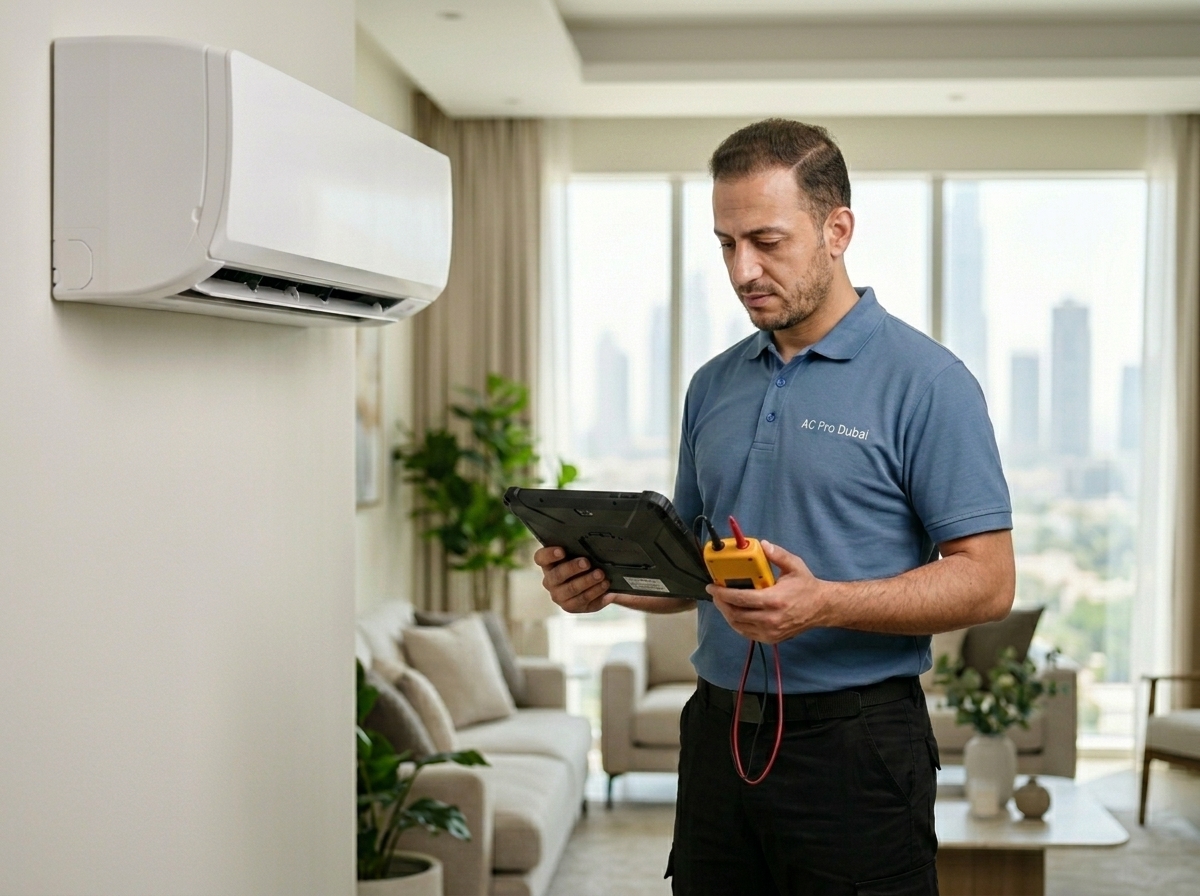
Five steps from your description to a system holding its full current, with every reading shown and every verdict earned. The readings are identical whoever built the unit, Carrier equipment included.
- Describe the pattern
When it trips: instantly, after minutes, or afternoons only. How often, and any smells or sounds alongside. The pattern pre-sorts the suspects before the van moves.
- Isolate and inspect
Power isolated properly, boxes opened, cables and glands examined, moisture hunted. The cheap and common causes get ruled in or out before instruments escalate.
- Measure the truth
Capacitance, winding resistance, insulation to ground and clamped running current, narrated as the readings land. The meter picks the suspect; nothing else does.
- Fix and protect
The convicted component repaired or replaced from van stock where possible, connections re-terminated, boxes sealed against the next humid week, breaker verified or renewed like for like.
- Prove it under load
Full running current held through a complete cycle while we watch, readings on the report beside the fixed-quote invoice and the 90-day workmanship warranty.
Owner Judgement
Trips, Timing and the Cost of Guessing
Four pieces of judgement that separate a AED 200 electrical fix from an August crisis, offered the way we offer them at the door. A breaker that holds while the room stays warm is a different diagnosis, set out under weak cooling.
The Pattern Is the Diagnosis
Before any visit, your observations are worth money: instant trips point at shorts and wet boxes; trips after minutes point at motors warming into failure; afternoon-only trips point at capacity margins and capacitors; random trips point at cables and ageing breakers. Send the pattern with your booking and the van arrives already halfway to the answer.
This is also why resetting endlessly destroys information along with margin: a fault allowed to show its pattern once or twice is diagnosable from your sofa; one hammered by twenty resets arrives scrambled, stressed and more expensive.
What Guessing Costs
The tripping AC attracts confident guesses like no other fault: it must be the compressor, says the first quote; needs a bigger breaker, says the second. The first guess costs four figures if you accept it unverified; the second risks your wiring to save a call-out fee. Measurement, at AED 150 to 300 credited into the repair, is the cheapest thing on this entire page.
Our AC repair team in Dubai retests other companies’ electrical verdicts weekly, and the reversal rate remains humbling. If a diagnosis arrived without a meter, treat it as a rumour with an invoice attached.
The Compressor Question, Kept Honest
Because instant trips raise the scariest possibility, know the standard of proof before anyone quotes: a compressor is condemned by insulation readings to ground, taken on a megger in front of you, not by the trip itself. Shorts elsewhere mimic the symptom precisely, at a tenth of the cost.
When the reading is genuinely fatal, the Dubai compressor page arithmetic applies: repair against replacement, in writing, decided by numbers and the unit’s age rather than by the fright of the moment. Fear buys badly; evidence buys once.
Retiring This Fault Permanently
Almost everything that trips a breaker was weakening measurably for months first: the capacitor reading low in March trips in June; the loose terminal warming in spring burns in August. One pre-summer electrical check catches the procession while every item on it is small money.
That check lives inside the annual service, alongside the coil wash that keeps compressor current honest. Homes on the rhythm meet this page as reading material; homes off it meet it at 3 PM in July, at the back of the busiest queue of the year. Same faults, different months, very different invoices.
Client Stories
Three Trips, Traced to the Amp
Three tripping breakers, three measured verdicts, three homes running steady.
“Every afternoon at the hottest hour, the villa’s main AC tripped. One company quoted a new compressor over the phone. AC Pro clamped the current, found a capacitor at half its rating and a condenser packed with sand, fixed both for a fraction of that quote, and the system has held through two full summers since. The meter saved us thousands.”
“Our AC tripped instantly every time it started, and I feared the worst. Their electrician found a connection box with condensate sitting in it, dried and resealed it, rerouted the drip that fed it, and load-tested everything while I watched the readings. Small invoice, huge relief, and a lesson in not guessing from the symptom.”
“An old breaker in our Jumeirah villa had started tripping at normal load, and two handymen wanted to fit a bigger one. AC Pro measured the AC innocent, replaced the tired breaker like for like, and explained exactly why upsizing would have been dangerous. That refusal to do the easy wrong thing is why they service the whole house now.”
Breaker FAQs
AC Tripping Breaker in Dubai: Direct Answers
The AC tripping breaker questions Dubai owners ask with a torch in one hand, answered with the panel closed and the meter out.
My AC tripped the breaker. Can I just reset it and carry on?
Once, and only once: that is the rule our electricians live by and the one we give every caller. A single trip can be an innocent event, a voltage wobble or a hot-day inrush, and one reset answers the question. If the breaker holds, monitor and mention it at your next service. If it trips again, stop entirely, because a breaker that keeps disconnecting has found a fault that keeps existing: a current leak, a short, or a component drawing far beyond its rating. Repeated resetting feeds electricity into that fault, heats the wiring and gambles the one system in your home built to protect the rest.
What are the most common causes of an AC breaker tripping?
Six causes cover nearly every case, ranked by how often we actually find them: a compressor drawing locked-rotor current as it struggles to start, usually because its capacitor has failed; moisture or condensate water inside an electrical connection box; a fan motor with shorted windings; cable insulation baked brittle by rooftop heat and vibration; a breaker itself aged weak from years of summer load; and, least often, a genuine short inside the compressor. Each has a distinct electrical fingerprint, which is why measurement beats replacement guessing every time.
Is an AC that trips the breaker dangerous?
The honest frame: the trip itself is safety working, and the danger begins when people defeat it. A breaker disconnects because current went somewhere it should not, at a level the circuit cannot safely hold. Left alone, that is a protected fault. Reset repeatedly, or worse, upgraded to a bigger breaker to stop the annoyance, it becomes heat inside your walls. Treat trips with respect, not fear: switch the AC off, leave the breaker to its opinion, and book an electrical diagnosis. What you should never do is silence the smoke alarm because it keeps going off.
Why does my AC trip the breaker only on hot afternoons?
Because afternoon is when everything peaks at once. At 45 degrees your compressor works against maximum head pressure and draws its highest running current; grid voltage in some districts sags at peak demand, which pushes motor current higher still; and a capacitor or breaker already weakened by age loses its remaining margin in the heat. The afternoon-only trip is a system running out of electrical headroom, and the diagnosis measures where the headroom went: dirty condenser, tired capacitor, sagging supply or weakening breaker. Most answers cost far less than people fear.
Could it be the breaker itself rather than the AC?
Genuinely, sometimes yes. Breakers are mechanical devices that age: years of summer heat cycles fatigue the trip mechanism until it disconnects below its rated current, and an AC drawing perfectly legal amps starts getting blamed for a component that has simply grown nervous. We test rather than assume: the AC’s actual draw gets clamped and compared with the nameplate, and the breaker’s behaviour speaks for itself. If the machine is innocent, the fix is a like-for-like breaker replacement by qualified hands, never a bigger one to buy silence.
What does it cost to fix an AC that trips the breaker in Dubai?
Ranked like the causes: capacitor and contactor replacements run AED 150 to 350 and resolve a large share of cases; drying, sealing and re-terminating a wet connection box sits in similar territory; fan motors span AED 350 to 800; cable repairs vary with access but usually land mid-range; a like-for-like breaker swap is modest; and only the confirmed compressor short reaches the AED 1,200 to 3,500 conversation, with the evidence shown first. Diagnosis at AED 150 to 300 credits into the repair, and the price guide publishes every band.
My AC trips the breaker immediately when it starts. What does that mean?
Instant tripping is actually the most diagnostic version of this fault, and it narrows the suspects usefully: a dead short in the compressor or fan windings, a shorted cable, or water sitting in a connection box making its own circuit. Instant trips are also the version where the one-reset rule matters most, because each attempt sends full fault current through the short. Switch off, leave it off, and book the diagnosis; the meter separates the cheap wet-box story from the compressor conversation in minutes.
Does DEWA wiring or my building’s electrics cause AC breaker trips?
Sometimes the story is upstream of your unit. Undersized circuits from decades-old installations, connections loosened by years of load cycles, and voltage sag at district peak all produce trips the AC gets blamed for. Older villas that added cooling capacity over the years without revisiting the wiring meet this most. Where the fault is supply-side, we document it plainly and correct what is ours to correct; where a new system is going in, our installation team sizes breakers and cabling to DEWA standards from day one, which prevents this page from ever applying.
Is a tripping AC an emergency at night or can it wait until morning?
Decide by pattern and smell. One trip, one reset, breaker holding, no burning smell: morning is fine, book the diagnosis. Repeated trips, any burning or hot-plastic odour, a breaker warm to the touch, or sparks and buzzing from any panel: leave everything off and call the emergency line, because those signs mean the fault is active rather than waiting. Households with vulnerable members losing cooling on a summer night also qualify for the emergency category with no apology needed; that is what the line exists for.
How do I prevent breaker trips before summer?
Electrical margin is built in spring. The pre-summer service load-tests capacitors before they weaken, inspects and torques connections before vibration loosens them, checks boxes for moisture paths before humidity finds them, and washes the condenser so the compressor never has to fight for its amps. Systems entering June with clean coils and healthy start components essentially retire this fault. It is the least visible part of an annual maintenance visit and, in breaker terms, the most valuable.
Let’s Talk Cooling
Get the Measured Verdict
Describe the trip pattern and any smells or sounds, and the diagnosis arrives with a meter, not a theory. One reset, then let the readings decide. Burning smell or warm panel: everything off, emergency line now.
Request Your Fixed Quotation
Free survey for installations · fixed quote within 48 hours · submits straight to our WhatsApp.