
The Most Searched AC Problem in Dubai
AC Not Cooling? Start Here, Not With a Gas Top-Up Six Causes, Ranked. Ten Checks, Free. One Honest Fix.
An AC not cooling in Dubai heat feels like catastrophe, but the fault behind it is usually ordinary and often cheap: nine times out of ten the culprit is dirty airflow, a struggling outdoor unit or a slow refrigerant leak, in roughly that order. This page is the diagnosis we would run in your living room: the causes ranked by real likelihood, the ten-minute self-check that costs nothing, the warning signs that separate a filter problem from a compressor problem, and the honest price of every outcome. Read it before you accept anyone’s guess, including ours.
Same-day slots · Fixed quotes · Licensed & insured
Ranked by Likelihood
The Six Reasons Dubai ACs Stop Cooling
A decade of aircon not cooling call-outs produces a league table. These six causes cover almost every case we meet, listed from most common to least, which is also cheapest to dearest.
1. Choked Filters and Matted Coils
Dubai dust turns filters into felt and coils into carpet, strangling the airflow cooling depends on. The system runs, the air moves weakly, the rooms stay warm. It is the most common cause on this list and frequently free to fix, which is why we rank it first and check it first.
2. A Suffocating Outdoor Unit
Sand in the condenser fins, a unit boxed in by storage, or plant growth stealing its breathing space: when heat cannot leave, cooling cannot happen. Weak cooling that collapses on hot afternoons is this fault’s signature, and a chemical wash is usually its cure.
3. Refrigerant Leaking Away
Gas does not get used up; it escapes. Cooling that fades over weeks, ice on the pipes and hissing joints point here. The fix is leak detection and repair before any refill, because gas poured into a leaking circuit is a subscription you never agreed to.
4. Electrical Components Failing
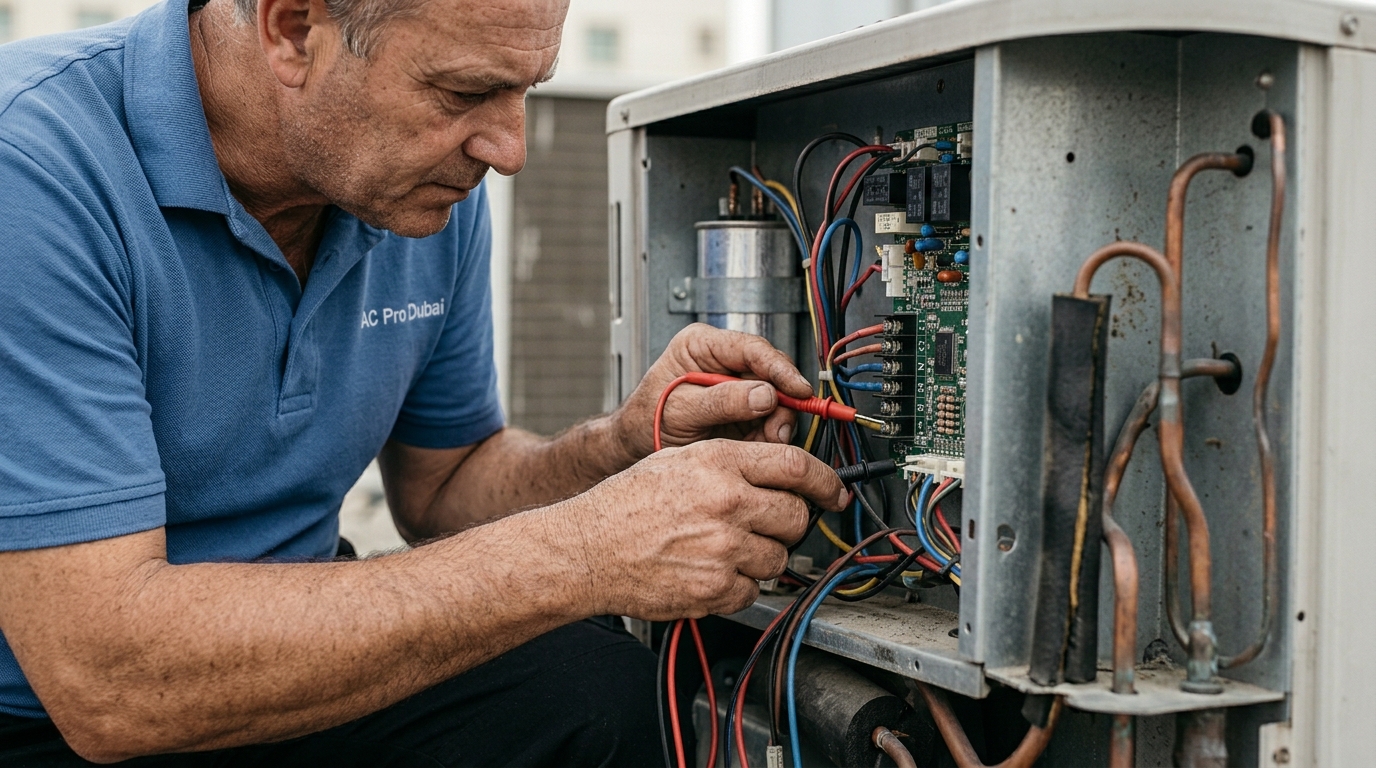
A weak capacitor lets the compressor hum without starting; a worn contactor connects nothing. The indoor fan blows air that was never cooled. Cheap parts, quick fixes, frequently misdiagnosed as something far more expensive by whoever quotes fastest.
5. Thermostat and Control Faults
Dead batteries, a mode switched to fan by a visiting toddler, a sensor reading the wrong wall: control faults make healthy machines look broken. Embarrassingly common, genuinely free to check, and always worth ruling out before a van is dispatched.
6. The Compressor Itself
Last on the list because it is genuinely the least common, whatever the scare quotes say. A true compressor failure needs instrument confirmation: winding readings, insulation tests, measured current. Never accept this verdict from a technician who has not opened his meter.
Before You Call Anyone
The Ten-Minute Self-Check That Costs Nothing
A meaningful share of not-cooling calls end without a technician, because the owner ran these checks first. Work through them in order; stop where the list tells you to stop.
Minutes One to Three: The Controls
Confirm the thermostat shows cool mode, the set point sits below the room temperature, and the display is alive; replace its batteries if it looks sleepy, because a dying thermostat produces the strangest symptoms on this page. Check any timer function has not been set accidentally.
If another remote lives in the house, try it. Control faults resolve more warm homes than anyone likes to admit, and they cost nothing but the walk to the wall. Fixed? Excellent. Not fixed? Three minutes well spent ruling out the free stuff.
Minutes Four to Seven: The Airflow
Open the filter access and look: if you cannot see light through the filter, wash it, dry it and refit. Walk the rooms confirming vents are open and unblocked by furniture, rugs or curtains. If the copper pipes or the coil are wearing ice, switch cooling off, run the fan alone and let it thaw completely, which can take two hours.
Ice is a message, not just a blockage: it means airflow or refrigerant is wrong. If ice returns after clean filters and a full thaw, stop here and book the leak test, because the next causes need gauges.
Minutes Eight to Ten: The Outdoor Unit
Look at the condenser: is the fan spinning when the system calls for cooling? Is the coil visibly matted with sand or fluff? Is anything stacked against it or growing over it? Clear the obvious, gently, and give it half a metre of free air on every side.
Then the breaker: if it has tripped, reset it exactly once. If it holds, monitor the day. If it trips again, do not touch it further; a breaker that keeps objecting is protecting you from an electrical fault, and that conversation belongs on our Dubai breaker tripping page and then with a technician.
Where the Self-Check Ends
Everything past this line needs training and tools: refrigerant pressures, sealed electrical panels, compressor measurements, duct internals. The self-check exists to catch the free fixes and to make you an informed customer for whatever remains, not to turn anyone into a technician.
What you learned in these ten minutes is diagnostic gold. Send it with your booking: which checks you ran, what the ice did, what the outdoor unit sounded like. A well-described symptom regularly turns two visits into one, and one visit into a smaller invoice.
Why AC Pro
Why Warm-Air Calls Come to Us Second, Then Stay
A painful share of our not-cooling work arrives after someone else’s guess did not hold. These six habits are why the second opinion tends to become the permanent number.
The Ranking Is the Method
We test causes in likelihood order, cheap before expensive, and show you each result as it lands. The AED 60 filter answer gets found before anyone spells compressor.
Gauges Before Gas
No refrigerant enters a system before a leak test explains where the last lot went. It is slightly slower and endlessly cheaper, and it is company policy without exceptions.
Ice Read Correctly
A frozen coil has exactly two causes and they need different fixes. We measure which one you have instead of thawing it and hoping, which is why our ice calls do not repeat.
Afternoon Failures Understood
Cooling that dies at 3 PM is a capacity story our climate writes daily. We test under load, at the hour it fails, rather than declaring a morning visit inconclusive.
Written Findings, Fixed Quotes
Every diagnosis arrives in writing with its evidence and a fixed price for the fix. You can compare it, sit on it or approve it; the number does not move afterwards.
The 90-Day Backstop
Whatever we fix carries our written workmanship warranty. If the same fault returns inside it, so do we, without a fresh call-out fee and without a debate.
Cooling Against a 45 Degree Sky
Dubai asks air conditioners to create a thirty degree difference between outside and in, every afternoon, for a third of the year. At that workload there is no slack: a ten percent airflow loss or a small gas shortfall that a milder climate would never notice here becomes a bedroom that will not drop below 28.
That is why not cooling is this city’s defining AC complaint and why the fixes are so satisfying: restore the margins the design assumed, clean coil, clear condenser, correct charge, and the same machine that embarrassed itself in August cools like the brochure again. The margins are the machine.
The Visit
From Warm Room to Verified Cold
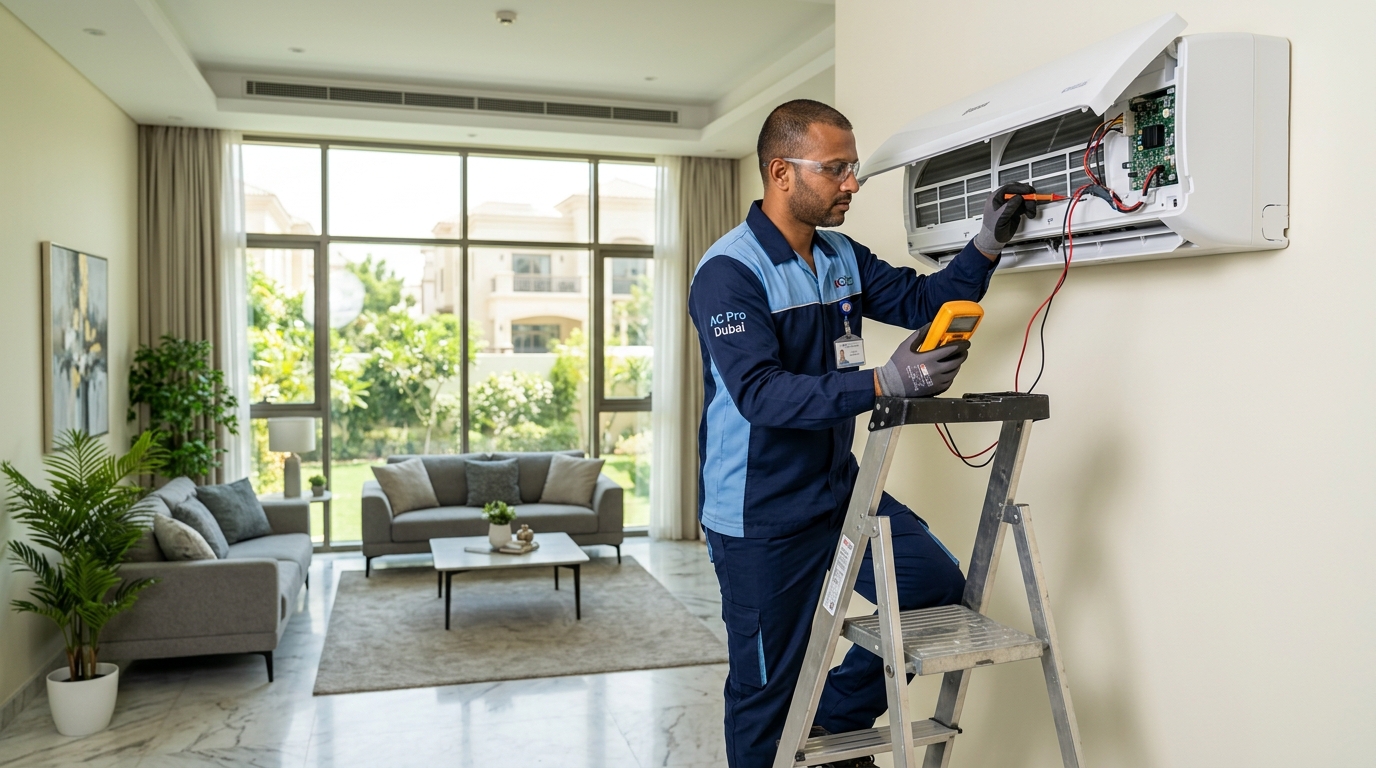
Five steps, most completed in a single visit, with the temperature split measured before and after so the fix is proven rather than promised.
- Describe it well
WhatsApp us the symptom pattern: warm always or afternoons only, ice or no ice, one room or all. Your self-check results shorten everything that follows.
- Likelihood-order testing
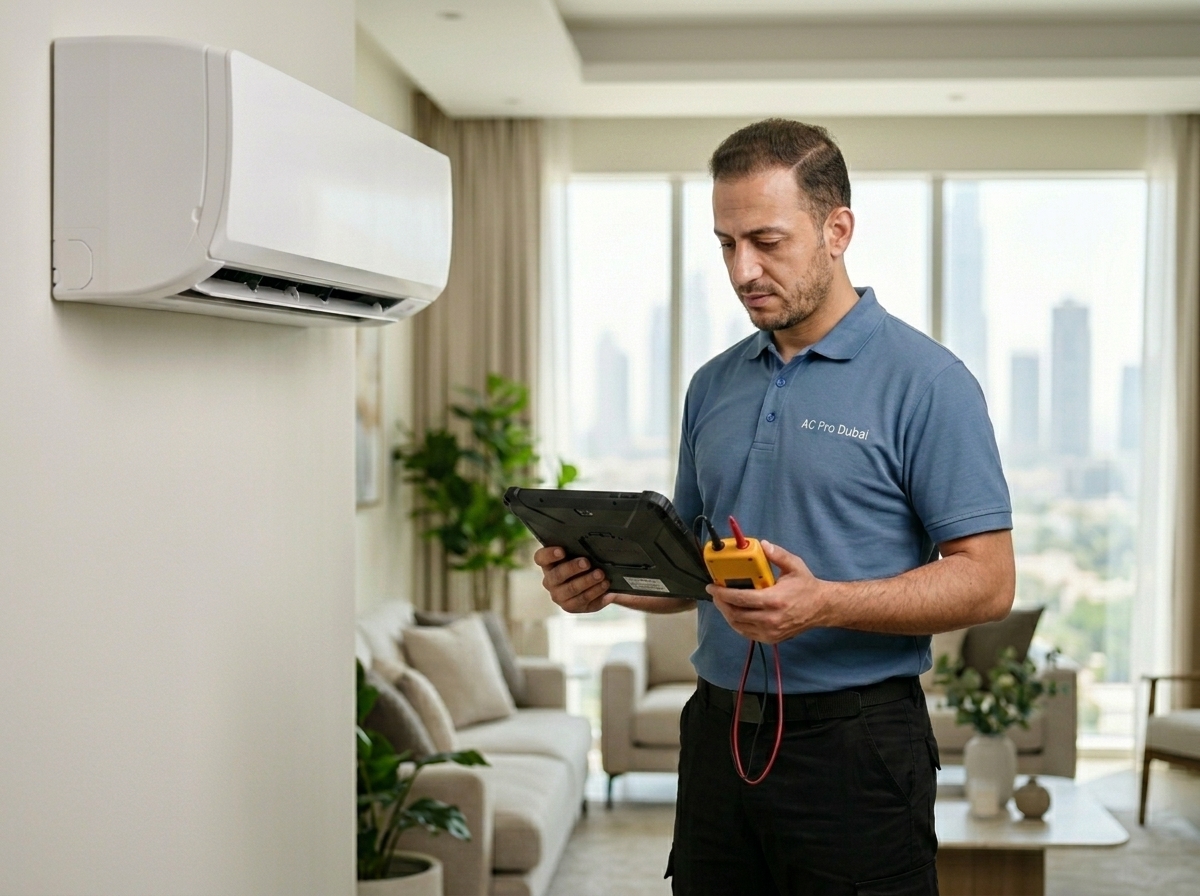
Filters, coils, condenser, pressures, electrics, controls, tested in the order faults actually occur, with you shown each reading as it lands.
- The written verdict
Cause named, evidence attached, fixed price quoted. If it is the compressor conversation, you get the readings and the repair-or-replace arithmetic side by side.
- The fix, same visit where possible
Vans stock filters, capacitors, contactors and cleaning chemistry, so most causes on this page end the same day they are diagnosed.
- Proof in degrees
Supply air temperature before and after, photographed readings, the 90-day warranty and an invoice matching the quote. Cold you can measure, not just feel.
Money and Urgency
What This Symptom Costs, and When It Cannot Wait
Two questions decide every warm-air call: what will the fix cost, and does it need to happen tonight. Honest answers to both, from the people writing the invoices.
The Price of Each Verdict
The comfort of this symptom is that its league table of causes is also its price list, cheapest first: cleaning work in the AED 150 to 450 band fixes the majority; refrigerant work with a proper leak repair typically runs AED 300 to 800; small electrical parts land between AED 150 and 350; and the compressor, the rarest verdict, spans AED 1,200 to 3,500 with the honest repair-or-replace arithmetic attached.
Diagnosis costs AED 150 to 300 and credits fully into any repair you approve. Beware of the reversed pyramid: any company whose most common finding is its most expensive service is running a different business model than diagnosis.
When Warm Air Is an Emergency
Most not-cooling cases are same-day problems, not middle-of-the-night ones. The exceptions deserve naming: vulnerable people in the home, indoor temperatures past the low thirties and climbing, a burning smell or repeated breaker trips alongside the warm air, or any commercial space where stock or equipment suffers.
For those, the emergency AC repair line in Dubai answers around the clock with published night supplements and no seasonal surge pricing. For everything else, tomorrow morning’s slot costs less and fixes it just as permanently.
The Compressor Question, Preempted
Because this symptom attracts that scare, arm yourself in advance: a genuine compressor failure is uncommon, announces itself with hard evidence, and must be proven to you with winding and insulation readings from a meter you watch. Our Dubai compressor page explains the full verdict process.
If a diagnosis reaches the compressor without passing through filters, coils, condenser and capacitor first, the diagnosis skipped the places the answer usually lives. Half of the condemned compressors we retest are healthy, which is a statistic worth carrying into any second quote.
Never Meeting This Page Again
The causes above share one prevention: a spring service that cleans the airflow path, verifies the charge and stress-tests the electrics before summer applies its load. Owners on that rhythm exit the not-cooling statistics almost entirely, which our repeat-customer numbers prove every year.
If your system is cooling again but this is its second or third wobble, consider the pattern the real symptom: an ageing system asking for scheduled care. The annual visit costs less than the diagnosis fee it replaces, and August stops being a gamble.
Client Stories
Three Warm Rooms, Fixed and Proven
Three warm homes, three different verdicts, one method that found each answer.
“Two companies quoted me gas refills without opening anything. AC Pro washed a coil so blocked you could not see metal, showed me the before and after photos, and the villa dropped four degrees by evening. No gas needed, half the price quoted elsewhere, and it has cooled perfectly for a year since.”
“Our bedroom unit iced up every week all summer. They measured instead of guessing: a slow leak at a flare joint, repaired and recharged by weight, with the pressures photographed for my file. The ice never came back. First company that treated the ice as evidence rather than the problem.”
“AC died at 2 PM on a 46 degree day with my mother staying with us. Emergency line answered, van arrived within the hour, capacitor swapped and cold air back before the school run. The invoice matched the rate card they read me on the phone, night supplement not even applicable. Faultless.”
Not-Cooling FAQs
AC Not Cooling in Dubai: Direct Answers
The questions Dubai residents ask when the cold stops, answered the way our dispatchers answer them at noon in July.
My AC runs all day but the room never gets cold. Why?
Because cooling needs three things working at once: airflow across the indoor coil, the right amount of refrigerant, and a condenser that can dump heat outside. An AC running but not cooling has lost one of the three. In Dubai the usual order of suspects is a choked filter or matted indoor coil first, a sand-blocked outdoor unit second, and a refrigerant leak third, with compressor and thermostat faults behind those. The engine of this page is exactly that ranking: check the cheap and likely causes before anyone mentions the expensive and rare ones.
Why is my AC blowing warm air in Dubai summer?
Truly warm air, rather than weak cool air, narrows the field usefully. Check the thermostat mode first, because a switch to fan or heat explains more warm-air calls than anyone admits. After that, warm air usually means the outdoor unit is not doing its job: tripped breaker, failed capacitor, seized fan or a compressor that hums without pumping. If the outdoor unit is silent while the indoor fan blows, that is where your fault lives, and our repair team diagnoses it with instruments rather than guesses.
What can I safely check myself before calling anyone?
Ten minutes of safe checks solves a surprising share of cases: confirm the thermostat is on cool and set below room temperature with working batteries; wash or replace filters if you can see grey felt on them; make sure supply vents and return grilles are not blocked by furniture or curtains; look at the outdoor unit for obvious blockage like a plastic bag on the coil; and check the breaker has not tripped, resetting it exactly once if it has. Stop there. Anything involving gas pressures, sealed panels or repeated breaker trips belongs with a technician.
Is it low gas? Everyone tells me it is low gas.
Sometimes it is, and often it is not, which is why the top-up trade thrives on this symptom. Genuine low refrigerant usually shows extra evidence: ice on the copper pipes or indoor coil, hissing near a joint, cooling that fades gradually over weeks, and short bursts of cold followed by warm. Even when gas is genuinely low, the gas is the symptom; the leak is the fault. A refill without leak detection is rent, not repair, which is why our gas refilling service starts with the leak test, always.
Can dirty filters really stop an AC from cooling?
They are the single most common cause we find, and the cheapest. A filter matted with Dubai dust throttles the airflow the coil needs, so the coil runs colder than designed, sometimes freezing solid into a block of ice that blocks air completely. The system then blows air that barely passed over anything cold. If your filters have not been washed in three months, do that first, let any ice thaw fully with the unit off and the fan on, and you may have fixed it for free. If the coil itself is matted, a chemical coil wash restores what a filter rinse cannot.
Why does my AC cool at night but not in the afternoon?
That pattern points at capacity being stolen rather than absent. In afternoon heat the system faces its maximum load, so any efficiency thief shows itself: a part-blocked condenser rebreathing hot air, slightly low gas, or a coil at seventy percent. At night the load drops and the crippled system copes again. The afternoon-only complaint is one of the most diagnostic sentences you can send us on WhatsApp, and it usually ends in a condenser wash or a leak test rather than a big repair.
How much does it cost to fix an AC that is not cooling in Dubai?
Ranked by how often we actually find each fix: filter and coil cleaning runs AED 150 to 450; a condenser wash sits in the same band; refrigerant work with proper leak detection typically lands between AED 300 and 800 including the repair; capacitors and relays run AED 150 to 350; and the rare compressor verdict spans AED 1,200 to 3,500. The call-out and diagnosis fee of AED 150 to 300 credits into whichever repair you approve, and the full price guide publishes every range so nothing on the invoice is a surprise.
My AC stopped cooling suddenly during a heatwave. Is that an emergency?
Treat it as one if anyone vulnerable is in the home: infants, elderly family, anyone medically fragile, or if indoor temperature is climbing past the low thirties. Sudden total loss in peak heat is usually electrical, a capacitor, breaker or contactor, which is fast to fix once someone qualified arrives. Our emergency AC repair line runs around the clock with published supplements and no heatwave surge pricing, and genuine emergencies jump every queue we have.
Why is only one room not cooling while the rest of the house is fine?
A single warm room almost always means a distribution problem rather than a machine problem. On ducted systems the usual culprits are a closed or failed damper, a crushed duct section, or airflow never balanced properly after installation. On multi-split setups it points to that room’s own unit or valve. The good news is that distribution faults are usually mid-range money, and fixing them often improves the whole system because it stops overcooling everywhere else to compensate for one struggling room.
How do I stop my AC losing its cooling again next summer?
The boring answer is the correct one: keep airflow clean and the charge tight. A yearly maintenance visit before the heat arrives washes coils, verifies refrigerant and catches the small electrical wear that becomes July’s breakdown. Between visits, rinse filters monthly in summer and keep the outdoor unit clear of storage and plant growth. Owners who follow this pattern almost never meet this page again, which is precisely the outcome we are selling.
Let’s Talk Cooling
Book the Diagnosis
Tell us the pattern: warm always or afternoons only, ice or none, one room or the whole home. The likelihood ranking does the rest, and the quote arrives fixed before the van does.
Request Your Fixed Quotation
Free survey for installations · fixed quote within 48 hours · submits straight to our WhatsApp.