
Silence Is a Symptom Too
AC Not Turning On? Silence Has a Short List of Causes. Two Minutes of Checks. Then a Meter, Not a Mystery.
An AC not turning on in Dubai heat feels like the worst-case fault, and it is usually the opposite: total silence has the shortest suspect list in air conditioning, and half of it costs little or nothing to fix. Dead remotes fake dead systems, flipped isolators and tripped breakers cut power invisibly, float switches shut units down to save ceilings, and only occasionally has a board or component genuinely retired. This page gives you the two-minute revival checklist, the honest meaning of each kind of silence, and the real price of every outcome, so a quiet machine never becomes a loud invoice.
Same-day slots · Diagnosis credited · Licensed & insured

Before You Call
The Two-Minute Revival Checklist
A meaningful share of ACs that won’t start in this city are revived by their owners in the time it takes to boil a kettle. Work the list in order; it is arranged from most likely to least. These checks are written for split system AC, the commonest setup in Dubai apartments.
The Remote Deception
Dead remote batteries produce a perfect imitation of a dead air conditioner, complete with the sinking feeling. Replace the batteries first, always, and test the emitter with your phone camera: a healthy remote flashes visibly on screen with each press. Spare batteries have resurrected more Dubai ACs than any tool on our vans.
While you are there, check the thermostat or display panel: alive and set to cool, below room temperature, with no timer icon quietly holding the system hostage until a schedule nobody remembers setting decides to allow cooling again.
The Power Path
Electricity reaches your AC through a chain with three visible links: the breaker in the distribution panel, any wall isolator near the indoor or outdoor unit, and in some homes a plug or fused spur. Check all three. Breakers get reset exactly once; isolators get flipped back with a sigh, because cleaners, painters and small children find them irresistible.
If the breaker re-trips on the next start attempt, stop: that is a different fault with its own rules, covered on our breaker page, and further resets only feed it. One reset is a test; two is a gamble with your wiring.
The Guardian Switch
If the unit died during or after humid weather, or has any history of dripping, suspect the float switch: a small device that cuts the system when the condensate tray fills, choosing your ceiling over your comfort. The clue is context: dampness near the unit, a previous leak, or a drain that has needed clearing before.
This one is not a DIY fix, but it is a cheap and satisfying professional one: the drain gets flushed and treated, the tray disinfected, and the system returns to life having genuinely saved you a repaint. Thank the switch; service the drain.
Where the Checklist Ends
Past these checks, the remaining suspects need instruments: control boards, transformers, receivers, internal fuses, contactors and, rarely, a compressor that no longer answers. Opening panels to poke at them without training risks both the machine and the hands, and voids exactly the components that might otherwise be warranty stories.
What your two minutes bought is precision: tell us which checks passed and failed, and the van arrives carrying the right parts for the shortlist that remains. A well-reported dead unit is very often a one-visit revival, which is the cheapest kind there is.
The Silent Suspects
What Total Silence Usually Means
When the checklist does not revive a unit, one of these six almost always explains it. Ranked by how often our meters actually convict each one. If it powers up but the room stays warm, the fault belongs on the AC runs but does not cool page instead.
Power Path Interruptions
Failed isolators, tired fuses, connections that finally let go after years of heat cycles. The most common professional finding behind true silence, and firmly at the cheap end: located with a meter, repaired at small-parts prices, load-tested before the van leaves.
Control Board Failures
The unit’s brain retires quietly after surge stress or years of rooftop heat: no response, no display, or displays that light but command nothing. Boards span AED 400 to 1,200 by model, and honest diagnosis matters because boards get blamed for many faults that are actually AED 40 power components beside them.
Float Switch Protection
Not a failure at all: the drain blocked, the tray filled, and the switch chose your ceiling over your cooling. Signature: silence after humid weeks or with damp history. Fix the drain and the system returns; ignore the lesson and it will protect you again next quarter.
Thermostat and Receiver Faults
Wall controllers age, wireless receivers fail, and connections between them corrode. Signature: unit ignores commands while power is confirmed present. Usually mid-range money at most, and far cheaper than replacing systems that were never actually broken.
Post-Surge Casualties
Grid events leave scrambled settings, blown fuses and stressed power sections behind. Signature: dead since the outage or the storm. Often revived with a proper reset and a small component; occasionally the board conversation, held honestly with the readings shown.
The Seized Compressor
Rarest and most feared: a compressor that no longer turns can present as silence or as instant breaker trips. Convicted only by measurement, winding resistance and insulation to ground, never by assumption, and always followed by written repair-or-replace arithmetic rather than pressure.
Why AC Pro
Why Dead Units Wake Up on Our First Visit
Silent systems reward methodical electrical work and punish guessing expensively. Six habits keep our revival rate where it is.
The Path Traced in Order
From breaker to board, the power path gets tested link by link with a meter, so the actual break is found rather than the most profitable one assumed.
Boards Defended From Blame
Control boards are the trade’s favourite expensive guess. Ours get accused only after their cheap neighbours, fuses, transformers, connections, are measured innocent.
Van Stock for the Shortlist
Fuses, contactors, common relays, float switches and universal receivers ride every van, which is why most silences end in the visit they were diagnosed in.
Safety Devices Respected
A float switch that cut your AC gets thanked and its drain fixed, never bypassed to make the symptom disappear while the tray plots against your ceiling.
Surge Stories Told Honestly
Post-outage faults get the measured version: what failed, what survived, and whether protection is worth adding, without the theatrical rewiring quote.
Revival Proven Under Load
Every fix ends with full start-stop cycles and running current checked against nameplate, then the 90-day workmanship warranty in writing. Awake means tested awake.
Why Dubai Kills Quietly
The failures behind a silent AC are mostly heat biographies: control boards living years at rooftop temperatures their designers called extreme, connections expanding and contracting through thousands of cycles until one summer afternoon they let go, surge events rolling through the grid at peak load. The silence is sudden; the dying rarely was.
That is the case for the spring electrical check in one paragraph: torque the connections, load-test the start gear, verify the board’s supply, treat the drain before the float switch has opinions. Systems that get that hour of attention almost never go silent in August, which is exactly when silence costs the most to end.
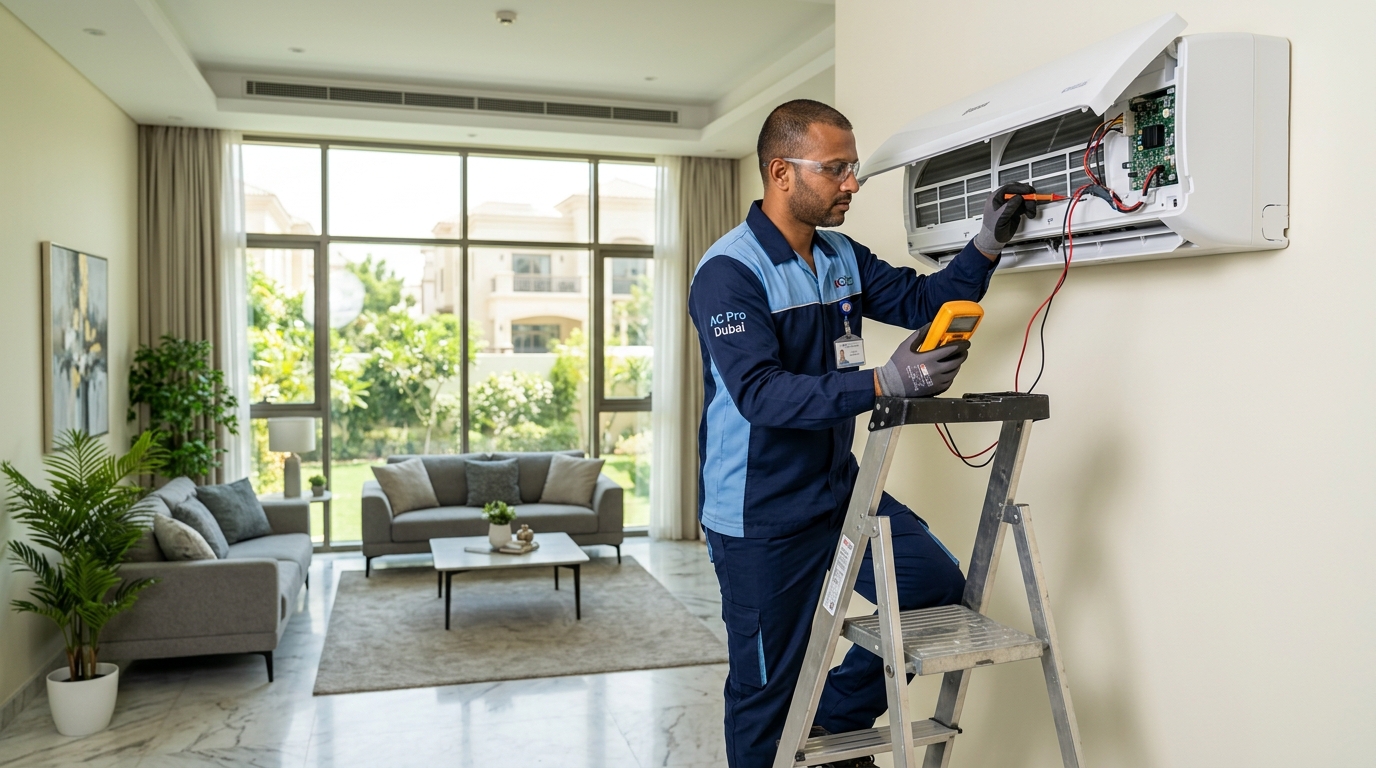
The Visit
From Silence to Verified Running
Five steps from your checklist report to a system proven awake, with every finding measured and priced before it is fixed.
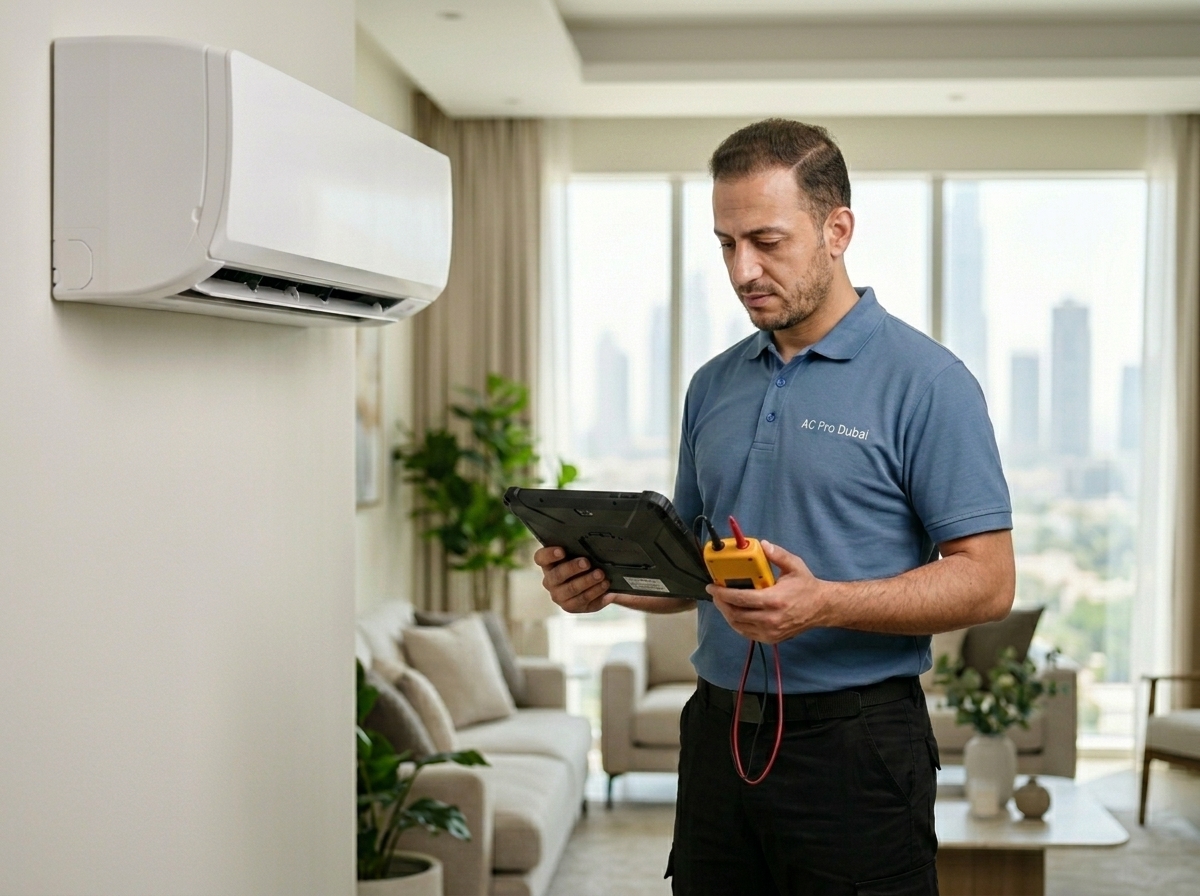
- Report the checklist
Which checks passed, which failed, and the context: after an outage, after humid weather, gradual or sudden. The shortlist forms before the van moves.
- Trace the power path
Breaker to isolator to unit terminals to board supply, tested in sequence with a meter until the break announces itself. No guessing, no skipped links.
- Convict with readings
The failed component measured in front of you, fuse, transformer, receiver, board or motor, with the cheap suspects cleared before any expensive verdict is spoken.
- Revive from van stock
Common parts fitted on the spot; board-level cases get the honest quote with model-specific pricing and timescale before anything is ordered.
- Prove it awake
Multiple full start cycles, running current against nameplate, controls tested from across the room, and the report, fixed-quote invoice and 90-day warranty closing the file.
Owner Judgement
Old Units, Hot Nights and the Price of Silence
Four judgement calls that decide whether a dead AC becomes a small story or an expensive one, told the way we tell them at the door. Brand decides parts lead time, and Carrier AC units in Dubai are among the ones we stock for on the van.
The Age Question, Asked Honestly
A dead unit is not a dying unit: plenty of ten-year systems revive for the price of a fuse and serve honourably for years. The question that matters is what died. Small electrical components fail without prejudice; a seized compressor or a fried board on an ageing system running retired refrigerant is arithmetic asking to be done.
We price both roads in writing when the finding justifies it: revival beside replacement, decided by the unit’s condition and your plans rather than by the temperature of the afternoon. Panic decisions in August are how the trade sells its worst deals; written numbers are how you decline them.
When Silence Cannot Wait
Most dead units are next-morning problems once the checklist has spoken. The exceptions are household ones, not technical: vulnerable people losing cooling in real heat, homes past the low thirties indoors and climbing, or any silence accompanied by burning smells or a warm panel, which upgrades the story from convenience to safety.
For those, the emergency line answers at any hour with published supplements and honest arrival windows. Everything else deserves the calmer, cheaper morning slot, and we will tell you which category you are in for free on WhatsApp rather than upsell the urgent version.
The Guessing Tax
Dead units attract expensive guesses because silence feels catastrophic: boards replaced that measured fine, systems condemned for a AED 60 fuse, thermostats swapped while the isolator sat flipped behind a curtain. Every one of those stories reached us second, after the guess was paid for.
The measured diagnosis costs AED 150 to 300, credits into the repair, and ends the guessing economy in one visit. On this page more than any other, the meter is not a formality; it is the entire difference between fixing the fault and funding the theory.
Retiring the Surprise
Silence is preventable in the same boring way most faults are: the annual electrical once-over that torques, load-tests and treats the drain before summer, catching the failing-in-slow-motion components while they are still small line items. Systems with that history keep their sudden deaths for genuine freak events, which are rare.
If your AC has already gone quiet once this year, treat it as the system requesting that appointment. Machines rarely send two polite warnings, and the impolite version always books itself at the least convenient hour of the hottest week.
Client Stories
Three Silences, Ended Same-Visit
Three silent systems, three causes, three same-visit revivals.
“Villa AC completely dead on a Friday in July, family melting. Their technician traced the power path and found a connection burned loose inside the isolator, repaired and load-tested it within the hour, and showed me the scorched wire. The AED figure had three digits, not four, and the honesty about how close we came to worse was free.”
“Our bedroom unit ignored the remote for a week and two shops sold me two universal remotes that changed nothing. AC Pro tested with a meter: the receiver had failed, not the remote, and the replacement cost less than my two guesses combined. The phone-camera trick to test remote emitters is now family knowledge.”
“Silent AC after a night of humidity, and I assumed the worst. The float switch had cut it to stop a blocked drain flooding the ceiling, which I did not know was possible. Drain flushed, tray treated, system alive in forty minutes, and a stain-free ceiling I owe to a switch I had never heard of. They also showed me the slime that caused it. Educational, cheap, done.”
Dead Unit FAQs
AC Not Turning On in Dubai: Direct Answers
The dead-unit questions Dubai households send us, answered before the panic spends anything.
My AC is completely dead. What should I check before calling anyone?
Run the two-minute revival list in order: fresh batteries in the remote, because dead remotes fake dead ACs daily; the thermostat display alive and set to cool below room temperature; the breaker in the panel, reset exactly once if tripped; any wall isolator switch beside the indoor or outdoor unit, because cleaners and curious children flip them more often than anyone believes; and the timer function, which sometimes gets set accidentally and politely refuses to start the unit until Thursday. This list revives a genuinely surprising share of dead systems for free, and whatever it does not revive, it narrows for the technician you then call.
Why would my AC suddenly stop turning on with no warning?
Sudden total silence is nearly always electrical, and the suspects rank neatly: a power path interruption, meaning breaker, isolator, fuse or a connection that finally let go; a failed control board that no longer hears the remote; a transformer or power supply component inside the unit that quietly retired; or a safety device doing its job, like a float switch responding to a full drain tray by refusing to run the system. Mechanical parts rarely cause total silence; they usually make noise or weaken first. Silence is the electrical section’s signature.
My remote works but the AC does not respond. What does that mean?
Point your phone camera at the remote’s emitter and press a button: a working remote shows a flashing light on the phone screen that eyes cannot see. If the remote flashes but the unit ignores it, the fault has moved into the unit’s receiver or control board, or the unit has no power at all, which sends you back to breaker and isolator. If the remote shows nothing, new batteries or a replacement remote solve the cheapest version of this page. Units with working displays that ignore commands usually need the receiver or board conversation, which is instrument territory.
What is a float switch and why did it turn my AC off?
A small guardian most owners meet only on the day it saves their ceiling. When the condensate drain blocks and the tray fills, the float switch cuts the unit rather than let the overflow reach your gypsum. A dead AC plus any dampness, drip history or recent humidity spike is this story until proven otherwise, and the fix is the drain, not the switch: flush the line, disinfect the tray, and the system returns to life on its own. It is the one cause on this page where the AC refusing to run is the machine actively protecting your home.
Can a power cut or voltage surge stop my AC from turning on afterwards?
Yes, and Dubai’s summer grid events write this story regularly. Surges and brownouts stress control boards and power supplies; some units survive with scrambled settings that a full reset clears, others lose a fuse or board component and stay silent. After any outage: give the unit ten minutes, then try a proper reset, breaker off for five minutes and on again. If it stays dead, the surge likely claimed something small inside, most often a fuse or the board’s power section, which is a measured diagnosis rather than a guess.
How much does it cost to fix an AC that will not turn on in Dubai?
By cause, honestly ranked: remote, batteries and settings cost nothing to almost nothing; fuses, isolators and connection repairs sit at the AED 150 to 300 call-out end, often absorbed by the credited diagnosis fee; float-switch events price as drain work at AED 150 to 350; control boards span AED 400 to 1,200 depending on the unit; and the rare seized compressor conversation runs AED 1,200 to 3,500 with evidence shown first. Diagnosis credits into any repair, and the price guide publishes every band so silence never becomes a blank cheque.
My AC breaker trips the moment I try to turn it on. Is that the same problem?
It is a different and more specific one, and usefully so. A unit that stays silent has a power path or control fault; a unit that answers every start attempt by tripping the breaker has current escaping somewhere it should not, which points at shorts, wet connection boxes or, more rarely, compressor windings. That version has its own dedicated page, AC tripping breaker, including the one-reset rule that protects your wiring. Either way: after one failed reset, stop resetting and book the measured diagnosis.
Is a dead AC an emergency in summer or can it wait?
Judge by household and heat. A dead bedroom unit in a home with other cooling can wait for tomorrow’s standard slot. A silent villa at 45 degrees, anyone vulnerable in the home, infants, elderly relatives, medical needs, or indoor temperatures climbing past the low thirties makes tonight the right answer, and the emergency line exists precisely for it, with published supplements and no summer surge pricing. Dead ACs are usually fast fixes once qualified hands arrive; the expensive part is only ever the waiting.
My AC is quite old and now it will not start. Should I repair it or replace it?
Let the diagnosis price the answer before sentiment does. Many dead old units revive for small money, a fuse, a contactor, a board repair, and owe you nothing for years more. The calculation changes when the silent component is the compressor on a system past ten years or running retired refrigerant: reviving it buys expensive time on borrowed arithmetic. Our rule is written options: the revival quote beside the repair-or-replace numbers, decided by unit age, condition and your plans rather than by the panic of a hot afternoon.
How do I stop my AC from dying suddenly again?
Sudden is usually only the last chapter. Boards fail after months of surge stress, connections burn after seasons of loosening, drains block after a year of slime, and every one of those was visible early to a technician with reason to look. An annual pre-summer service inspects and torques the electrical path, load-tests the start components, treats the drain that trips float switches and leaves the system with margin instead of luck. Homes on that rhythm meet this page rarely, which is the entire argument for the maintenance visit in one sentence.
Let’s Talk Cooling
Report the Silence
Tell us which revival checks passed and failed, and the shortlist forms before the van moves. Most silent systems restart the same visit, at the small end of the price list, with the readings to prove it.
Request Your Fixed Quotation
Free survey for installations · fixed quote within 48 hours · submits straight to our WhatsApp.