
Renting In Dubai
Who Pays for the AC in a Dubai Rental Landlord or Tenant, What Article 16 Actually Says, and Whose Bill Each Fault Is.
Some time in August a tenant finds the flat sitting at 31 degrees, and a landlord finds a message he would rather not have received. Both of them are almost always arguing from half the law. Dubai tenancy law does give a clear default answer, and then four words in the very same sentence hand it straight back to whatever the contract says. This is what Articles 16, 17, 19 and 21 actually require, a fault by fault table of who normally pays for what, and the short sequence that gets the cooling back on instead of turning into a dispute.
Default position: the landlord. Unless your tenancy contract says otherwise, which is the clause almost nobody reads before signing. Article references below are to the law as published by the Government of Dubai Legislation portal, checked October 2026.

The Law
What Dubai law actually says
The relationship between a landlord and a tenant here is governed by Law No. 26 of 2007, as amended by Law No. 33 of 2008. Four of its articles decide who pays for a broken air conditioner. Almost every argument we are called into has been caused by one party reading one of them and none of the other three.

| Article | What it says | What that means when the AC fails |
|---|---|---|
| Article 16 | Unless otherwise agreed by the parties, the landlord is responsible during the lease term for the property’s maintenance works and for repairing any defect or damage that affects the tenant’s intended use. | Cooling is the intended use of a home in this city. A system that cannot cool is a defect, and by default it is the landlord’s to put right. |
| Article 17 | The landlord is responsible for defects, damage, deficiencies and wear and tear that are not caused by the tenant’s fault. | A part that died of age, dust or a design weakness is not your fault. A part that died because you blocked a drain or ran the unit with no filter is. |
| Article 19 | The tenant must maintain the property in the manner an ordinary person would maintain his own, and may not carry out maintenance works without the landlord’s permission. | You are expected to keep filters clean and to report faults. You are also not free to hire whoever you like, pay, and take it off the rent. |
| Article 21 | At the end of the term the tenant surrenders the property in the condition in which it was received, allowing for ordinary wear and tear or damage beyond his control. | A compressor that reached the end of its life is wear and tear. A snapped louvre or a hole drilled through a duct is not. |
One detail that gets misquoted constantly
Law No. 33 of 2008 rewrote eleven articles of the 2007 law, specifically Articles 2, 3, 4, 9, 13, 14, 15, 25, 26, 29 and 36. Article 16 was not one of them. The maintenance rule people quote at each other is the original 2007 wording, and it has stood untouched for close to two decades. If somebody tells you the maintenance law changed, it did not.
What the law does not do
Nowhere does it mention air conditioning. There is no article saying the landlord shall service the air conditioner twice a year, and no stated repair deadline. The law sets a principle and leaves the detail to your contract, which is exactly where every dispute actually lives.
The Fine Print
The four words that decide it
Unless otherwise agreed by the parties. Those words sit at the front of Article 16, and they are the reason two neighbours on the same floor of the same tower can get opposite answers to the same question. The law hands the default to the landlord and then lets your contract take it back, and a great many contracts in this city do exactly that.
Where to look
Not the Ejari certificate. The clause lives in the terms and conditions of the tenancy contract itself, or in the addendum stapled behind it, usually under a heading like maintenance or obligations of the tenant. Find it, note the clause number, and read it twice. If the contract says nothing at all about maintenance, Article 16 applies in full and the landlord carries it.
The threshold clause
The commonest shape is a split by value. Repairs below a stated figure are the tenant’s, anything above it is the landlord’s. That figure is a negotiated convention rather than a legal standard, so it moves from contract to contract. Treat it as a deductible on an insurance policy, not as a rule of law.
The blanket clause
Older contracts sometimes say the tenant bears all maintenance for the term. The opening words of Article 16 permit that, and tenants sign it without noticing. It is also the most expensive line in the document if the system is fifteen years old, which in parts of International City, Discovery Gardens and the older Marina towers it often is. At that age the real question stops being what the next repair costs and becomes what a replacement unit costs, and which clause leaves you holding it.
Changing it
You cannot rewrite a maintenance clause mid term. You can change it at renewal, and Article 14 as amended in 2008 requires whichever party wants a change to notify the other no less than ninety days before the contract expires. Put that date in your calendar the week you move in, because missing it costs you a year.
Fault By Fault
Whose bill is it, fault by fault
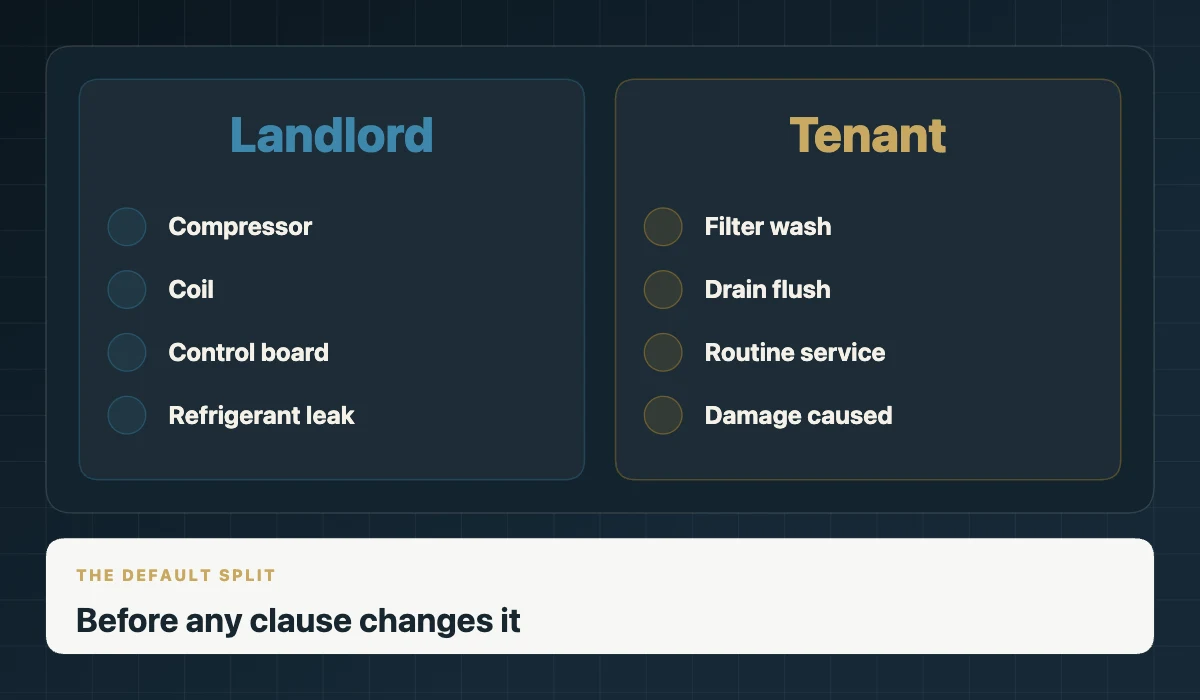
This is the part a property manager will not put in writing, because answering it needs somebody who has actually had the unit open. The table assumes your contract is silent and the Article 16 default applies. The last column is what tips each one the other way, because that is what you will be arguing about.
| The fault | Normally falls on | Why, and what changes it |
|---|---|---|
| Compressor failed, no cooling at all | Landlord | A sealed component reaching the end of its life is wear and tear under Article 17. Nothing a tenant does from a wall thermostat kills a compressor. See AC not cooling for how this is diagnosed. |
| Refrigerant low or empty | Landlord | A sealed system does not consume gas. If it is empty there is a leak in a coil, a flare or the pipework, and that is a defect in the property. Insist the leak is found, not just that the gas is topped up, or the same bill arrives next season. |
| Filters clogged, airflow weak | Tenant | Washing the indoor filters is the clearest example of the ordinary person standard in Article 19. In this climate that is monthly, not annually. |
| Condenser coil packed with dust | Usually landlord | The coil is installed plant and clearing it properly needs tools, water access and a technician. Coil cleaning moves to the tenant only where the contract has handed over routine servicing. |
| Water dripping from the indoor unit | Depends | A drain pan blocked by accumulated dust is routine servicing. A cracked pan, a corroded tray or a drain line that was never pitched correctly is an installation defect, which is the landlord’s. Water leaking from an AC explains how to tell them apart. |
| Breaker trips when the AC starts | Landlord | An electrical fault in the property, usually a failing capacitor, a tired contactor or an undersized circuit. Article 16 covers it squarely and it is also a safety matter, so do not keep resetting it. |
| Smell coming from the vents | Depends | Mould grown in ductwork over years of humidity predates your tenancy and is the landlord’s. A smell traced back to your own neglected filters is not. |
| Thermostat or control board failed | Landlord | A fixture supplied with the property. A handheld remote you lost or dropped is a separate and much smaller conversation. |
| Rattling, humming or vibration | Landlord | Bearings, fan mounts and compressor mounts are plant wear, not usage. |
| Ducts never cleaned since handover | Landlord | A pre-existing condition at the start of your lease. Photograph the return grille before you raise it, then ask for duct cleaning rather than a filter change. |
| Damage caused by the tenant | Tenant | Hosing the outdoor unit at the wrong angle, hanging laundry over it, boxing it in with storage, drilling a mounting bracket through a pipe. All of these are real, all of them are chargeable. |
| System too small for the flat | Landlord | Article 15 requires the property to be handed over in a condition that allows the intended use. An undersized system never allowed it, and no amount of servicing will. |
The one sentence that resolves most of it
Anything sealed, wired or built in belongs to the landlord. Anything you can reach with a vacuum cleaner belongs to you. That is a fair summary of how Articles 16, 17 and 19 read together, and it settles the great majority of these before anyone needs to quote a statute at anyone. Where the argument is about a whole unit rather than a repair, what decides repair against replacement gives you the evidence to put in front of a landlord.
The exception worth knowing
Neglect cuts both ways. If a landlord can show the system failed because filters were never touched for two years, Article 17 stops protecting the tenant, because the damage was caused by the tenant’s fault. Equally, if a tenant can show a coil was already filthy on day one, no wear and tear argument survives it. A fouled coil is also costing you money while the argument runs, because it is your DEWA bill that pays for the extra current and not the landlord’s. Which is why the evidence matters more than the law.
Making The Case
Four things that settle this, and one that never does
Most landlords here are not being obstructive. They are individual owners being asked to authorise a few thousand dirhams on the strength of a text message that says the AC is not working. Give them something they can verify and the majority of these end the same day.

A written diagnosis
Not a complaint, a report. One page naming the failed part, the measured readings and the cause, from a licensed contractor. This is the single fastest lever, because it turns an argument into an invoice the owner can check. Any AC repair in Dubai worth paying for comes with one.
Dated photographs from move in
Take them in your first week. The outdoor unit, the filters, the return grille and the service sticker if there is one. A photo of a coil already blanketed in dust on day three ends the wear and tear debate before it can begin, and it takes ninety seconds.
Notice in writing, dated
An email or a message you can produce later, stating the fault and the day you reported it. Article 16 obliges the landlord to repair, but the clock on that obligation only starts once he knows. A verbal mention to a watchman is not notice.
The clause, quoted back
Cite the clause number and its exact words. Most owners in this market are individuals who have not reread the contract since the day they signed it, and a surprising number discover their own document says the opposite of what they assumed.
What never works
Hiring a contractor yourself, paying, and deducting it from the rent. Article 19 bars a tenant from carrying out maintenance works without the landlord’s permission, and withholding rent hands him a ground to act against you. Get approval in writing first, even one line in a reply.
If it genuinely deadlocks
The Rental Disputes Centre at the Dubai Land Department hears it. The published filing fee is 3.5 percent of the annual rent with a floor and a ceiling, your Ejari registered contract is required, and every document must be in Arabic or officially translated. For a single repair that arithmetic rarely favours either side, which is the real reason a contractor’s report is the cheaper move.
Three Situations
Chiller buildings, villas and splits are not the same argument
Where you live decides who owns which piece of equipment, and that shifts the answer more than the contract wording does. Most of the confused advice online comes from people applying a villa answer to an apartment on district cooling.
Apartments on district cooling
Across much of Downtown, Business Bay, the Marina, Jumeirah Lake Towers and the Palm, chilled water arrives from a central plant run by a provider rather than from a condenser on your balcony. You do not own a compressor and neither does your landlord. What sits in your apartment is a fan coil unit above the ceiling, a thermostat and a chilled water valve. The plant belongs to the building, the fan coil belongs to the property and therefore to the landlord, and the filter belongs to you. Arguments here are almost always about the valve or the fan coil, not the cooling supply.
Apartments on split or ducted systems
The condenser on the balcony or the roof is part of the leased property. Everything from that unit through to the grille in your ceiling falls under Article 16 unless your contract moves it. This is the setup where threshold clauses cause the most friction, because a filter wash and a gas leak can land on opposite sides of the same figure, and nobody agrees in advance which is which.
Villas
Villa tenants carry the most, for two reasons. Villa contracts push routine servicing across more often, and villas simply have more plant: several outdoor units, long pipe runs, and ducts that have been collecting fine dust for a decade. If you are signing for a villa with servicing in your column, price an annual maintenance contract into your offer before you sign rather than discovering it in July.
In Order
What to do when it stops cooling and nobody will own it
Follow this sequence rather than jumping to the end of it. It gets the AC running soonest and it also leaves you in the strongest position if the matter does go further. If the flat is already unbearable, an emergency call out can get cooling back while the responsibility question is settled separately.
1. Rule out the two things that are not a dispute
Wash the indoor filters and check nothing is blocking airflow around the outdoor unit. A fair share of August call outs are one of those two, and you would much rather find that out before you email your landlord about a defect.
2. Read your clause, not a forum thread
Find the maintenance line in your own contract and note its number. Everything that follows depends on what your document says, not on what somebody heard from a friend in another building.
3. Report it in writing the same day
A short factual message: the date, the symptom, and a request to arrange repair. No accusations and no legal threats at this stage. You are creating a timestamp, and that timestamp is worth more later than any amount of indignation now.
4. Offer a diagnosis rather than a demand
Propose that a licensed contractor attends and reports, and agree in writing who pays for that visit. Owners say yes to this far more readily than to an open ended repair, because a report caps their exposure instead of expanding it.
5. Get the repair approved in writing before work starts
Once the report names the part and the cause, responsibility is usually obvious to both sides. Secure the go ahead in a message you can keep, then let the work proceed. This is the step that protects you under Article 19.
6. Escalate only once he stops replying
A reminder, then a stated deadline, then the Rental Disputes Centre. Very few of the jobs we attend get past step four, and the ones that do are almost always cases where nothing was ever put in writing.
For Owners
If you are the landlord, the arithmetic is not close
Most owners we deal with hold one or two units and resist maintenance spending because it reads as a cost with no return. On a Dubai property it is the cheaper of the two options, and not by a small margin.
Reactive is the expensive option
A compressor running for years on a fouled coil and a slow leak does not fail politely. It fails in July, and it usually takes the capacitor and sometimes the contactor with it. Compressor work costs several multiples of the servicing that would have prevented it, and you pay it at the worst possible moment of the year.
It protects the rent, not only the unit
A tenant who spends a Dubai summer arguing about cooling does not renew. Re letting costs agency commission plus an empty month, which comfortably exceeds a year of servicing on the same property.
Twice a year is the honest number
Not because a manual says so, but because of what this city does to a condenser. Dust plus humidity plus eleven months of running means a coil needs clearing before the season and checking during it. A straightforward AC maintenance visit covers both, and what that costs is published rather than quoted on the day.
Write it down and be done with it
State who does what, name a figure if you want a threshold, and give your tenant a contractor to call. Ambiguity is what produces disputes, not generosity. A clause of three clear sentences has saved more landlord tenant relationships in this city than any amount of goodwill.
Straight Answers
Questions tenants and landlords ask us
The same eight, in roughly this order, every summer.
Is my landlord legally required to fix the AC in Dubai?
By default, yes. Article 16 of Law No. 26 of 2007 makes the landlord responsible for the property’s maintenance and for repairing any defect that affects your intended use of it, and a home that cannot be cooled here plainly fails that test. The exception is in the same sentence: unless otherwise agreed by the parties. Read your contract before you rely on the law, because your contract may have moved it.
Who pays for AC gas refilling, the landlord or the tenant?
Normally the landlord. A sealed system does not consume refrigerant, so an empty one means a leak, and a leak is a defect in the property rather than a consumable. Ask for the leak to be located and repaired rather than simply topped up, otherwise the same bill returns the following season and the second one is harder to argue about.
My tenancy contract says I pay all maintenance. Is that enforceable?
Generally yes. Article 16 opens with unless otherwise agreed by the parties, and that is precisely what allows a contract to shift maintenance onto the tenant. You can try to renegotiate, but only at renewal, and the party seeking a change must give at least ninety days notice before the contract expires under Article 14 as amended in 2008.
Can I repair the AC myself and deduct it from the rent?
Do not. Article 19 prevents a tenant from carrying out maintenance works without the landlord’s permission, and withholding rent creates a separate and larger problem for you. Get a written approval first, even a single line in a reply, then arrange the work.
Who pays for AC duct cleaning in a rented property?
Where the contract is silent, the landlord, because ducts are installed plant and the dust inside them almost always predates your tenancy. Where routine servicing has been passed to the tenant, duct cleaning tends to travel across with it, so check the wording of that clause rather than assuming either way. It also pays to know which of the four jobs sold as AC cleaning that clause is actually asking you to fund.
Does the landlord have to service the AC if it still works?
The law speaks about repairing defects, not about a servicing schedule, so there is no stated frequency to point at. In practice an unserviced system in this climate becomes a defect, and that argument is far easier to make with a contractor’s written report in hand than without one.
Who is responsible in a chiller or district cooling building?
The central plant belongs to the building. The fan coil unit, the thermostat and the chilled water valve inside your apartment are part of the leased property, so they follow Article 16 and sit with the landlord. Keeping the fan coil filter clean is yours. If a room never reaches setpoint, the usual culprits are that filter or the valve, not the plant.
How long does my landlord have to carry out the repair?
The law sets no number. It states the obligation, which in practice means a reasonable period judged on the circumstances, and in a Dubai summer a failed air conditioner is not a slow repair by any reasonable reading. Report it in writing so the date is fixed, follow up against a stated deadline, and keep every reply.
Settle It In Writing
Get the fault named in writing
Tell us the symptom, the building and whether you are the tenant or the owner. We attend, diagnose and hand over a written report naming the failed part, the readings and the cause, which is the one document that ends most of these arguments in a day rather than a month. Our repair work carries a 90 day warranty.

Request Your Fixed Quotation
Free survey for installations · fixed quote within 48 hours · submits straight to our WhatsApp.