
Before You Replace Your AC In Dubai
Repair or Replace Your AC in DubaiFour Tests Settle It, and One of Them Has a Deadline Attached.
A technician hands you a number and waits. Spend it on a system you have already stopped trusting, or spend several times as much on a new one. Most advice at this moment is either a sales pitch or a list of vague warning signs. Deciding whether to replace your AC in Dubai or repair it is an arithmetic problem rather than a feelings problem. This is the method we actually run on site: four tests, taken in order, each producing an answer you can check for yourself. Three of the four need nobody but you and a phone torch.
There are no prices on this page. The figures that move with tonnage, district and access live on the cost page, where they are kept current instead of being copied here and left to rot. This page is the decision, not the invoice.
The Method
The four tests that decide whether to replace your AC in Dubai
Each test can end the decision on its own, which is why the order matters. Work down the list and stop at the first one that gives you a clear answer. If you reach the bottom without one, the system is genuinely borderline, and that is useful to know too.
| Test | What you are measuring | Leans repair | Leans replace |
|---|---|---|---|
| 1. Age | Years since the unit was manufactured, read off the nameplate | Under eight | Twelve or more |
| 2. Repair pattern | How many separate components have failed in twenty four months | One component, once | Two or more major parts |
| 3. Running cost | Current draw against the nameplate figure, with clean coils | Close to the original spec | Climbing year on year |
| 4. Refrigerant | The gas printed on the outdoor unit | R410A or R32 | R22 |

Why the order is not arbitrary
Age is first because it is free and instant. Refrigerant is last because it rarely decides alone, but when it does it overrules everything above it. The two in the middle need either your paperwork or a meter, so they cost you something to run.
Three of the four need no technician
Age, repair pattern and refrigerant are all readable by you, today, without an appointment. That is deliberate. If you walk into the conversation already knowing three of the four answers, a quote becomes much harder to inflate.
The fourth needs a clamp meter
Running current against the nameplate figure is the one measurement that separates a tired system from a dirty one. Ask for it. A verdict offered without it is an opinion wearing the clothes of a diagnosis, which is the subject of our page on AC repair in Dubai.
Test One
How old the system really is
Not how long you have lived there, and not when the building handed over. Equipment gets swapped, and plenty of Dubai flats are on their second or third unit without the tenant ever being told. The only honest source is the metal.

Where the real date is written
Go to the outdoor unit and find the rating plate, usually on the side panel nearest the pipework. It carries a model number and a serial number. Most manufacturers encode the month and year of production in the first four to six characters of the serial. Photograph it. If the plate has faded in the sun, which happens fast on a west-facing balcony, the same information is on the indoor unit behind the front flap.
Why ten years is the line everyone quotes
ENERGY STAR lists an age of more than ten years as one of its signals to start considering replacement, alongside rising bills, frequent repairs, uneven temperatures and noise. It is a starting point rather than a verdict, and the published guidance on when it is time to replace is explicit that you weigh several signals together rather than acting on age alone.
What this climate does to that number
A unit in a temperate country spends part of the year switched off. A Dubai unit runs for most of the year, often for eighteen or more hours a day between May and October, and it does it while pulling salt-laden air through a condenser on a balcony. Nobody has published a clean, independent figure for how much life that costs, and we are not going to invent one. What we can say from our own service calls is that the condition spread at ten years here is enormous, and maintenance history explains most of it.
Under eight years
Repair, in almost every case. A system this young with a single failed component has most of its design life ahead of it, and the parts that fail at this age are the cheap ones: capacitors, contactors, fan motors, sensors. Check whether any manufacturer warranty survives before you approve anything.
Eight to twelve years
Condition decides, which means the other three tests do the work. This is the band where an honest technician will spend longer looking at the coil and the insulation than at the part that failed, because the question is no longer what broke but what is about to.
Past twelve years
The burden of proof flips. A major repair now has to justify itself against a new system that will be quieter, cheaper to run and under warranty. Small repairs can still be worth it if the rest of the system is sound and you have a reason to keep it, such as a lease ending in a year.
Test Two
The pattern in the repairs, not the last repair
One failure is an event. Three failures in two years is a system telling you something, and the thing it is telling you is rarely about the part that failed most recently. Count components, not call-outs.
| What happened | What it usually means | Where it points |
|---|---|---|
| One fault, one component, fixed once | Ordinary wear on a consumable part | Repair |
| The same fault twice | The first visit treated a symptom and left the cause | Diagnose again, do not replace yet |
| Two or more different major parts | The system is reaching the end of its design life together | Replace |
| Gas added more than once, no leak repaired | You are being sold the same gas twice | Stop and pay for a leak test |
| Years of silence, then one large failure | Neglect rather than age | Let tests three and four decide |
Major parts and minor parts
Treat the compressor, the condenser coil, the evaporator coil, the main PCB and the outdoor fan motor as major. Capacitors, contactors, sensors, remotes and drain work are minor and should not count towards a replacement decision no matter how often they come up. If a compressor has actually been confirmed as failed, that single item carries more weight than everything else in this table.
Repeat gas is its own answer
A sealed system does not consume refrigerant. If it has been topped up twice, there is a leak that nobody has found, and a third top-up will buy you another season at best. Insist on a leak test before any refill, and do not let the repair or replace conversation start until the result is in.
Keep the paperwork, it is the test
Most people cannot run this test because nobody wrote anything down. Every visit should leave you with a report naming the component, the cause and the readings. If your contractor does not produce one as standard, that is worth more attention than any individual quote, and it is the reason we build written reports into every maintenance visit.
Test Three
What it costs you to keep it running
An old system does not announce its age. It bills you for it, quietly, every month, and in Dubai the billing structure makes that worse than most people expect.
The slab is what makes this expensive
DEWA bills residential electricity on a rising block that resets monthly, and it publishes the slab tariff openly: 23 fils per kWh for the first 2,000 units, then 28, then 32, and 38 fils above 6,000. A tired system does not add units at the cheap rate. It adds them at the top of whichever block you are already in, which is why the same inefficiency costs a studio very little and a villa a great deal.
Compare the system with itself
Brochure efficiency figures are useless here. The comparison that means something is August against last August, on the same flat, with the same number of people in it. If consumption has climbed two years running while occupancy has not, the system is working harder for the same cooling. Our guide to where the money on a DEWA bill actually goes sets out how to read the pattern.
Clean the coil before you judge the bill
A fouled condenser makes a healthy system behave exactly like a dying one. Before you let a rising bill argue for replacement, have the coils washed properly and take a fresh reading. A proper coil clean costs a fraction of a new system, and it is the cheapest way to find out whether you have an old AC or just a dirty one.
The reading that settles it
Running current, measured at the outdoor unit with a clamp meter and compared against the full load amps printed on the nameplate. A system drawing close to its original figure with clean coils is doing its job. One drawing well above it, with coils already washed and charge verified, is converting your money into heat rather than cooling.
On district cooling this test does not apply
If you live in Downtown, Business Bay, the Marina, Jumeirah Lake Towers or on the Palm, your cooling probably arrives as chilled water from a central plant and appears on a provider invoice rather than your DEWA bill. The fan coil unit in your ceiling uses very little electricity. Judging it by your DEWA consumption will tell you nothing, and central and chilled water systems need a different test entirely.
What this test cannot tell you
It cannot separate a failing compressor from poor insulation, leaking ducts, or a neighbour’s wall that bakes all afternoon. It tells you the system is costing more than it should. Finding out why is a different job, and anyone who jumps straight from a high bill to a replacement quote has skipped it.
Test Four
Which gas is inside it, and why that has a date on it
This is the test almost nobody runs, and it is the only one with an international treaty behind it. It takes ninety seconds and it can override every other answer on this page.

Ninety seconds with a phone torch
Same rating plate as test one. Somewhere on it, usually near the charge weight in grams, is the refrigerant designation. You are looking for one of three strings: R22, R410A or R32. If the plate is unreadable, the pipework gives a hint, but do not guess from pipe size alone. Photograph the plate and ask.
R22, and the date attached to it
R22 is a hydrochlorofluorocarbon, an ozone-depleting substance being withdrawn worldwide under the Montreal Protocol. It is not a question of fashion or of one country’s policy. Production and import of the gas are being stepped down on a published schedule that every party to the treaty has signed, and the schedule has very little room left in it.
What the schedule actually says
For developing country parties the baseline is the average of 2009 and 2010 consumption. Consumption froze in 2013, then fell 10 percent in 2015, 35 percent in 2020 and 67.5 percent from 1 January 2025, reaching 100 percent on 1 January 2030. After that only a servicing allowance of 2.5 percent of baseline remains, averaged across the decade to 2040. In plain terms, the gas your old unit runs on is being switched off on a timetable.
Where the UAE sits in this
The UAE acceded to the Montreal Protocol in December 1989 and accepted the Kigali Amendment in April 2024, and it operates licensing systems for both ozone-depleting substances and hydrofluorocarbons. Ministerial Decree No. 138 of 2023 sets out how HFCs are handled here, with registration, permits and quarterly reporting for anyone importing or trading them. The direction of travel is not ambiguous.
What this does to a repair quote
Scarcity has a price, and it only moves one way. A large repair on an R22 system is not just a repair, it is a bet that you can keep buying a gas with a legislated end date, at whatever it costs by then, for the remaining life of a unit that is already old enough to be running R22. That is a poor bet even when the repair itself is sound.
The one case where this test decides alone
R22 plus a confirmed compressor failure. A burnout contaminates the circuit, the system has to be flushed and recharged in full, and you are buying a large volume of a disappearing gas to put into a system that cannot be converted cheaply. We have never seen that arithmetic come out in favour of repair.
R410A and R32 are the working present
If the plate says either of these, test four is neutral and the decision goes back to the first three. R32 is the newer of the two, carries a lower global warming potential, and is what most new splits sold here now use. Neither is under any near-term supply pressure in the UAE.
What a new unit has to meet now
Anything sold legally in the UAE today has to comply with the national energy efficiency standard for air conditioners, UAE.S 5010-1:2019, enforced from 1 January 2021 with a valid conformity certificate and an energy label on the box. That is the floor, not the ceiling. It means a replacement bought today is held to a standard your 2011 unit never had to meet, which is a real part of the running cost difference rather than a sales claim.
The Verdict
When to replace your AC in Dubai, and when to repair it
Four answers rarely all point the same way, and the repair or replace verdict comes from how they combine. Here is how to weigh them, and what to ask for once you have.
Two or more pointing the same way
ENERGY STAR applies a simple counting rule to its own replace and repair checklists: if two or more items fall in the replace column, it is time to consider a new system. Our four tests work the same way. Two clear replace signals is enough to stop spending on the old one, and a single one almost never is. That is the threshold at which we would tell you to replace your AC in Dubai rather than keep patching it.
When the tests disagree
An eight year old R410A unit with one failed fan motor and a flat bill is a repair, even if it feels old. A six year old unit on R22, which does happen with grey imports and old stock, needs the refrigerant question answered before anything else. Age and refrigerant usually move together, and when they do not, trust the plate over the calendar.
The quote you should ask for
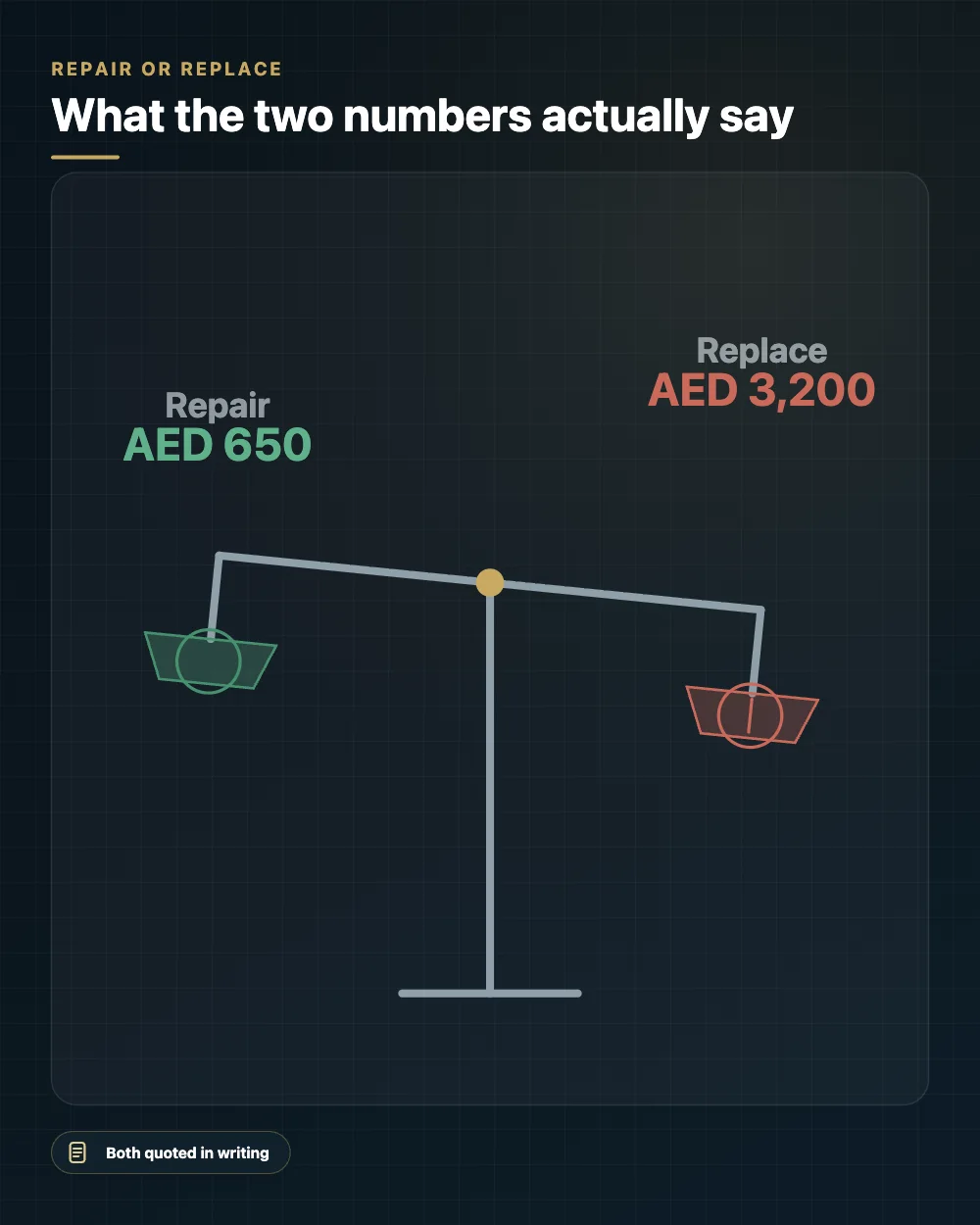
Both numbers, side by side, in writing, from the same person on the same visit. Repair cost with what it buys you and for how long, against replacement cost fully installed. Anyone willing to give you only one of those two numbers has decided for you. Our page on what AC work costs in Dubai sets out the bands so you can sanity check both.
What a replacement quote must include
Removal and disposal of the old unit, recovery of the old refrigerant rather than venting it, new brackets where the old ones have corroded, a stated decision on whether the existing pipework is reused or replaced, drain line checked and re-run if needed, and commissioning readings on completion. A quote that is only a box price plus fitting is missing most of the job, which is why we publish the full scope on our AC installation page.
Pipework is where cheap replacements go wrong
Reusing old copper is sometimes fine and sometimes the reason the new system fails in its second summer. R410A and R32 run at higher pressures than R22, and a line set that has carried R22 for a decade may hold oil residues that are not compatible. If a quote reuses pipework it should say so, and say why it is safe to.
What we will tell you not to do
Do not replace a working system because the bill went up before anyone has cleaned the coils and checked the charge. Do not approve a compressor on a system nobody has measured. Do not buy a bigger unit than the room needs because the old one struggled, since oversizing produces a cold, clammy room and short cycling rather than comfort. And do not replace one unit at a time across a villa purely to spread the cost, because the install crew’s mobilisation is a real part of what you pay.
Once you have decided to replace
Two decisions follow and they are independent of each other. Size comes first, worked from the room rather than copied off the old label, which is what our AC size calculator for Dubai rooms is for. Brand comes second, and it matters less than most showrooms suggest, which is the argument in our comparison of which AC brand suits Dubai conditions.
If you keep it, change how you keep it
A system that survives this decision has earned a maintenance schedule rather than a rescue service. Annual cleaning with readings, a drain flush before summer, and filters washed monthly will get more years out of it than any single repair will. Where several units are involved, an annual maintenance contract spreads that across the year.
Special Cases
Three Dubai situations the usual advice gets wrong
Most advice on whether to replace your AC in Dubai is borrowed wholesale from articles written about a detached house with a furnace in the basement. Very little of that survives contact with a Dubai tower.
You are on district cooling
There is no compressor of yours to fail. What you have is a fan coil unit above the ceiling, a thermostat and a chilled water valve, and the plant belongs to the building. Replacement here means a new fan coil or a new valve, not a new air conditioner, and tests three and four do not apply at all. The questions that matter are coil condition, valve behaviour and drain fall, which is the territory of chilled water and chiller side maintenance.
You rent, and somebody else owns the unit
Then the decision is not entirely yours, and the four tests become evidence rather than a verdict. A written report naming the component, the age and the refrigerant is what turns a request into a case. Dubai tenancy law puts major failures and full unit replacement with the landlord in most circumstances, and we set out the detail in our guide to who pays for the AC in a Dubai rental.
It is a ducted villa system
Ducted systems fail differently and cost differently. The indoor unit sits in a ceiling void or a plant cupboard, the ductwork is part of the system, and a replacement that ignores the duct condition will underperform from day one. Judge the whole assembly rather than the box, and read the duct survey before you accept any number. Our page on ducted AC systems in Dubai covers what changes.
Straight Answers
Repair or replace your AC in Dubai: questions we get asked
The nine that come up on almost every call, answered the way we answer them on site.
How long should an air conditioner last in Dubai?
Longer than most people expect when it is maintained and shorter than the brochure when it is not. ENERGY STAR treats ten years as the point to start considering replacement, and that is a reasonable anchor here too. We will not quote you a Dubai specific lifespan figure, because the numbers circulating online come from individual companies’ own service records rather than from any independent study, and we are not going to build your decision on marketing data.
How do I find out how old my AC is?
Read the rating plate on the outdoor unit. The serial number usually encodes the month and year of manufacture in its first few characters, and the model number lets a technician confirm it. Do not rely on when you moved in or when the building completed, because units get swapped and the replacement rarely gets recorded anywhere you can see.
Is it worth repairing an AC that is more than ten years old?
Small repairs, often yes. Major ones, usually not. A capacitor or a fan motor on a twelve year old unit that is otherwise sound and running on R410A is money well spent. A compressor on the same unit is money spent on borrowed time. The dividing line is whether the failed part is a consumable or one of the system’s major components.
Is R22 banned in the UAE?
It is being phased down rather than switched off overnight, and the distinction matters. Under the Montreal Protocol schedule that applies to developing country parties, HCFC consumption fell 67.5 percent below baseline from January 2025 and reaches a full 100 percent reduction on 1 January 2030, with only a small servicing allowance after that. The UAE is a party to the Protocol and operates an ozone-depleting substance licensing system. The practical effect for an owner is supply that keeps tightening and a price that keeps rising, on a published timetable.
How do I know if my AC uses R22?
It is printed on the rating plate of the outdoor unit, usually beside the charge weight. If your system was installed before roughly 2012 and has never been replaced, R22 is a realistic possibility and worth checking before you approve any significant work. Photograph the plate and send it to whoever is quoting.
Will a new AC really cut my DEWA bill?
Usually yes, and the size of the gain depends on which DEWA slab you are in rather than on the unit alone. Because the tariff rises in blocks, the same saved kilowatt hour is worth considerably more in a villa running above 6,000 units a month than in a studio. Anything sold legally in the UAE today has to meet the national efficiency standard enforced since January 2021, which your older unit never had to. That said, have the coils cleaned and the charge verified first, because a dirty system flatters a replacement quote.
My landlord wants to repair instead of replace. Can I insist?
You cannot insist, but you can make the case properly. A written report that names the failed component, the age from the plate, the refrigerant and the readings turns an argument about preference into a document about condition. Dubai tenancy law places major failures with the landlord in most circumstances, and a landlord who understands that a second compressor is coming often changes position without a dispute.
Should I replace all the units in a flat at the same time?
If they were installed together and are all past the age line, replacing together is usually cheaper per unit, because mobilisation, scaffolding and access are a real share of the cost. If one unit is clearly younger or clearly healthier, there is no technical reason to throw it out. Judge each unit on the four tests and let the economics of a single visit decide the grouping.
Does a cheap compressor replacement ever make sense?
Not at the price that usually attracts people to it. A compressor change done properly includes recovery of the old charge, a new filter drier, a deep vacuum that is held and proven, and a weighed charge. Remove those steps and the price drops a long way, and so does the life of the result. If a compressor quote is dramatically below the others, ask which of those four steps is missing.
Ask First
Not sure whether to fix it or replace it
Send us the rating plate photo, the age if you know it and what has been repaired in the last two years. We will run the four tests and give you both numbers in writing, repair and replace, with the reasoning attached. If the honest answer is that it has years left in it, that is what the report will say, and our repair work carries a 90 day warranty. If the readings show a fault rather than dirt, the job moves to AC repair and gets quoted separately before anyone opens a panel.

Request Your Fixed Quotation
Free survey for installations · fixed quote within 48 hours · submits straight to our WhatsApp.