
Before You Buy
What Size AC Do I Need in Dubai Room Sizes, Tonnage and a Calculator Built for This Climate, Not a Milder One.
Most AC sizing charts online were written for countries where summer tops out in the low thirties. Use one in Dubai and it will tell you a small unit can cool a room several times the size it actually can. This guide gives you the tonnage Dubai rooms really need, a calculator that adjusts for the things that change the answer here, three worked examples from typical flats and villas, and the signs that the unit you already have is the wrong size.
A starting point, not a survey. Every size here assumes an ordinary room. Glass, roofs and how a space is used can move the answer by a full size, which is why we measure before we quote. Figures and sources checked November 2026.

The Quick Answer
AC size by room in Dubai: the quick chart
Measure the floor, find the band, then read the section after the calculator before you buy. Where a room sits in the building matters almost as much as how big it is.
| Floor area | Typical room | Starting size | Cooling per hour |
|---|---|---|---|
| Up to 11 m² (120 sq ft) | Small bedroom, study, maid’s room | 1 ton | 12,000 BTU |
| 11 to 17 m² (120 to 180 sq ft) | Standard bedroom | 1.5 ton | 18,000 BTU |
| 17 to 20 m² (180 to 220 sq ft) | Master bedroom | 1.5 to 2 ton | 18,000 to 24,000 BTU |
| 19 to 23 m² (200 to 250 sq ft) | Apartment living or dining room | 2 ton | 24,000 BTU |
| 23 to 33 m² (250 to 350 sq ft) | Large living room, open plan, majlis | 2.5 ton, or two smaller units | 30,000 BTU |
| Over 33 m² (350 sq ft) | Villa living areas, whole open-plan floors | Two or more units, or a ducted system | Needs a survey |
Why online charts get Dubai wrong
The ENERGY STAR guidance published by Natural Resources Canada sizes a room at 200 BTU per hour for each square metre. That is a sensible figure for Ottawa. The bands above work out at roughly 1,050 BTU per square metre, about five times as much, because a room here is fighting summer afternoons of 45 to 50 degrees. Put a Dubai bedroom into a generic calculator and it will cheerfully recommend half a ton.
When you land on a boundary, go up
A unit chosen at the very bottom of its range has no headroom left for a July afternoon. If your room sits near the top of a band, take the next size. With an inverter unit the larger size simply runs slower for most of the day, so it rarely costs more to run than a smaller one working flat out. Cutting a DEWA bill covers the running cost side in detail.
Work It Out
AC size calculator for Dubai rooms
Enter the room in metres. The calculator starts from the chart above and applies the same adjustments we make on a survey. It gives you a starting size to price, not a guarantee, and it will tell you when a room is too big for one wall unit.
Your result appears here. Nothing you enter is sent anywhere.
Beyond The Floor Area
Six things that change the answer in Dubai
Floor area gets you into the right band. These six decide where in the band you land, and two of them can push a room up a full size on their own.

West-facing glass and afternoon sun
From May to September the afternoon sun pours straight through west and south glazing, and a floor-to-ceiling window wall in a Marina or JLT tower can add more heat than the rest of the room put together. LG’s own guidance for the UAE is to add half a ton for a west-facing room, and on full-height glass we often find that is the minimum.
Top floor, or a roof directly above
A concrete roof soaks up sun all day and keeps radiating it into the room below well after dark. A bedroom that takes 1.5 ton two floors down often needs 2 ton on the top floor of the same building. Villa first floors under a flat roof behave the same way.
Ceiling height
Sizing tables assume a ceiling of about 2.8 metres. A double-height villa living room or a 3.5 metre townhouse ceiling holds a quarter to a half more air, and the size needs to rise with it. The calculator above scales for height automatically.
How many people use the room
People are heat sources. ENERGY STAR guidance adds 600 BTU for each person beyond two who regularly uses the room. It barely matters in a bedroom. In a majlis or a dining room that seats ten, it adds up to half a ton.
Kitchens and open-plan spaces
If the kitchen is open to the living area, the AC is cooling the hob, the oven and the fridge’s heat exchanger as well. The same guidance adds 4,000 BTU for a kitchen, which is why an open-plan apartment so often feels warmer than its floor area suggests.
Problems that look like an undersized AC
Before you buy a bigger unit, rule out the faults that make a correctly sized one struggle: a blocked filter, a coil packed with dust, or refrigerant lost through a leak. All three cut cooling sharply and none of them is fixed by more tonnage. AC not cooling walks through how we tell them apart.
Worked Examples
Three rooms, worked out the way we size them
The same arithmetic the calculator uses, written out so you can follow it. Notice that in two of the three, it is not the floor area that sets the final size.
| The room | What we measured | The working | Starting size |
|---|---|---|---|
| JVC apartment, second bedroom | 4.0 by 3.5 m, 2.8 m ceiling, ordinary window, flat above, two people. | 14 m² x 1,050 = 14,700 BTU. No adjustments. | 1.5 ton. A 1 ton unit would fall almost a fifth short on a summer afternoon. |
| Dubai Marina master bedroom | 4.5 by 4.2 m, 2.8 m ceiling, full-height west-facing glass, two people. | 18.9 m² x 1,050 = 19,845 BTU, plus 6,000 for the glass = 25,845 BTU. | 2.5 ton. The glass, not the floor, set this. Good blinds or heat-reflective film can bring it back towards 2 ton, which a survey can confirm. |
| Villa living room with an open kitchen | 7 by 5 m, 3.5 m ceiling, kitchen open to the room, usually four people. | 35 m² x 1,050 = 36,750, x 1.25 for the ceiling = 45,940, plus 4,000 for the kitchen and 1,200 for two extra people = 51,140 BTU. | More than one wall unit should carry. Two units on opposite walls, or a ducted system. |
Why the villa answer is two units, not one big one
A single wall split that large throws cold air hard across one end of the room and leaves the far end warm, and the largest wall units are loud. Two smaller units, or ducted grilles spread across the ceiling, put the cooling where people actually sit. Ducted AC and cassette units are the usual answers for big open spaces.
Why the Marina bedroom is a glass problem
The same room with a solid west wall and one ordinary window would take 2 ton. Before you pay for the extra half ton every summer for ten years, it is worth pricing what it costs to stop that heat getting in through the glass in the first place.
Wrong Size, Real Symptoms
Too big or too small: how to tell which one you have
Both mistakes are common in Dubai and they feel completely different. Bigger is not the safe choice, and the reason has more to do with humidity than with temperature.

Too big: it switches off within minutes
An oversized unit hits the set temperature fast and shuts down before the cycle is complete. Trane calls this short cycling, and the constant stopping and starting is hard on the compressor.
Too big: cold but clammy
An air conditioner removes moisture as well as heat, and that takes running time. A unit that is too large cools the air before it has dried it, which leaves the room feeling damp. In a humid August on the coast, that is the giveaway.
Too big: hot and cold patches
Short bursts of very cold air do not have time to mix through the room. You end up cold under the unit and warm by the window, and turning the set point down makes it worse, not better.
Too small: it never stops running
On a July afternoon an undersized unit runs flat out for hours and still does not reach the temperature you set. The room is comfortable at night and miserable from two until six.
Too small: the bill climbs
A unit running at full output all afternoon uses more electricity across a summer than a correctly sized one that spends most of the day ticking over, so the money saved at purchase leaks back out through the DEWA bill.
The simple test
Watch it on a hot afternoon. Switching off within a few minutes and the room feeling sticky points to too big. Running for hours without reaching the set point, with a clean filter and a healthy system, points to too small.
Replacing An Old Unit
Replacing an old unit: do not just copy the label
Most of the sizing mistakes we see were made at replacement time, by reading the tonnage off the old unit and ordering the same again.
The old size may never have been right
Trane names replacing a unit with the same size without a load calculation as one of the main causes of oversized systems. If the old unit short cycled or never kept up, copying its tonnage copies the problem for another ten years.
The room may have changed
A wall knocked through, a kitchen opened up, a balcony enclosed in glass. Any of those changes the load, and the label on a unit fitted before the work tells you nothing about the room as it is now.
Old fixed speed versus a new inverter
A fixed-speed unit only knows full power or off. An inverter varies its compressor speed to hold the temperature, so a correctly sized inverter covers a wider range of conditions. Replacing an old fixed-speed unit is the moment to get the size right rather than to go a size up for safety. Before size comes the earlier question of whether the old unit is worth replacing at all.
On district cooling, the size is not your call
Much of Downtown, Business Bay, the Marina, JLT and the Palm runs on chilled water from a central plant. The fan coil above your ceiling was sized when the building was designed. If one room is hot, the cause is almost always airflow, a valve or the thermostat rather than the size of the unit.
Units Explained
Tons, BTU and kW in one table
Shops in Dubai label the same unit three different ways. One ton of refrigeration is 12,000 BTU per hour, or about 3.5 kW of cooling. To get from BTU to tons, divide by 12,000.
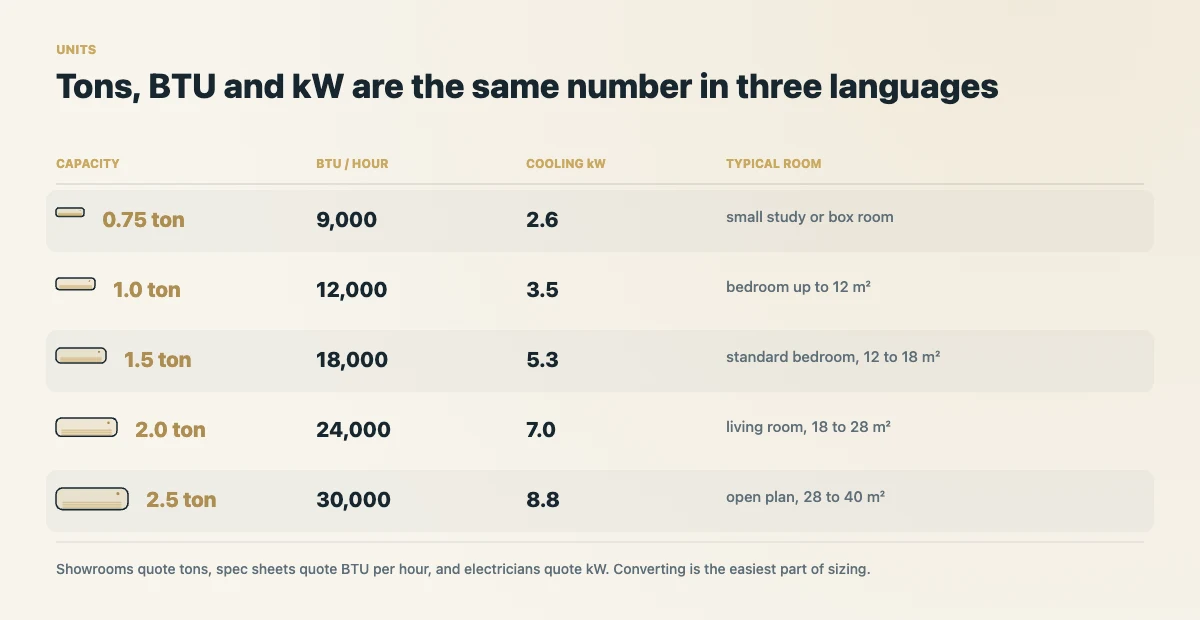
| Tons | BTU per hour | kW of cooling | Typical use in Dubai |
|---|---|---|---|
| 0.75 | 9,000 | 2.6 | Small study or maid’s room |
| 1 | 12,000 | 3.5 | Small bedroom up to about 11 m² |
| 1.5 | 18,000 | 5.3 | Standard bedroom |
| 2 | 24,000 | 7.0 | Master bedroom or apartment living room |
| 2.5 | 30,000 | 8.8 | Large living room or sun-loaded master bedroom |
| 3 | 36,000 | 10.6 | Largest common wall split. Above this, use two units or ducted |
Cooling output is not power use
A 2 ton unit delivers about 7 kW of cooling but draws far less than 7 kW of electricity, because an air conditioner moves heat rather than making cold. How much less depends on the unit’s efficiency rating, which is the number to compare when you are choosing between models. Which AC brand to buy in Dubai covers what to look for.
BTU on the box means per hour
An 18,000 BTU unit removes 18,000 BTU of heat every hour at full output. It is a rate, not a total, so comparing BTU between two models tells you which one cools harder, not which one costs more to run.
Straight Answers
Questions we get asked about AC sizing
The eight we hear most, usually while someone is standing in an electronics shop.
What size AC do I need for a 12 by 12 room in Dubai?
A 12 by 12 foot room is 144 square feet, or about 13.4 square metres, and in Dubai that is a 1.5 ton room. A 1 ton unit is only enough if the room is shaded, has another floor above it and is used by one or two people. If it faces west or sits on the top floor, look at 2 ton.
Is a 1.5 ton AC enough for a living room?
Only a small one. A 1.5 ton unit suits rooms up to about 17 square metres, or 180 square feet. A typical apartment living room of 19 to 23 square metres, or 200 to 250 square feet, is 2 ton territory, and an open kitchen or west-facing glass pushes it higher.
How many square feet does a 1 ton AC cover in Dubai?
About 100 to 120 square feet, or 9 to 11 square metres, in a typical room. Charts written for temperate countries suggest several times that, which is why so many units bought from generic advice struggle here in July.
Is it better to buy a bigger AC to be safe?
No. An oversized unit cools the room before it has removed the moisture, so it switches off early and leaves the air feeling damp and clammy. It also stops and starts far more often, which wears the compressor. Go up a size only when the room sits near the top of a band or has one of the heat sources described above.
Does a 2 ton AC use more electricity than a 1.5 ton?
At full output, yes. Over a summer it depends on the room. A 1.5 ton unit that runs flat out all afternoon in a room too big for it can use more than a 2 ton inverter that spends most of the day at low speed. The right size for the room is the cheapest one to run.
How do I convert BTU to tons?
Divide by 12,000. An 18,000 BTU unit is 1.5 ton, a 24,000 BTU unit is 2 ton, and a 9,000 BTU unit is three quarters of a ton. One ton is also about 3.5 kW of cooling.
What size AC do I need for a villa?
Size it room by room rather than as one number. Bedrooms follow the chart above, rooms under the roof take roughly half a ton more, and large living areas usually need two units or a ducted system rather than one big wall split. A whole villa is where a survey stops being optional.
Can I change the AC size in a district cooling apartment?
Not usually. The fan coil was sized when the building was designed and any change goes through the building management. If one room is too warm, the cause is almost always a dirty filter, weak airflow, a sticking valve or the thermostat, and all of those can be fixed without touching the unit’s size.
Ask First
Not sure your room fits the chart
Send us the room’s length and width, which way the windows face and what floor you are on. We will tell you the size we would fit and why, before anyone mentions a price, including when the honest answer is that your current unit is the right size and needs a service instead. Surveys for installations are free, and our repair work carries a 90 day warranty.

Request Your Fixed Quotation
Free survey for installations · fixed quote within 48 hours · submits straight to our WhatsApp.